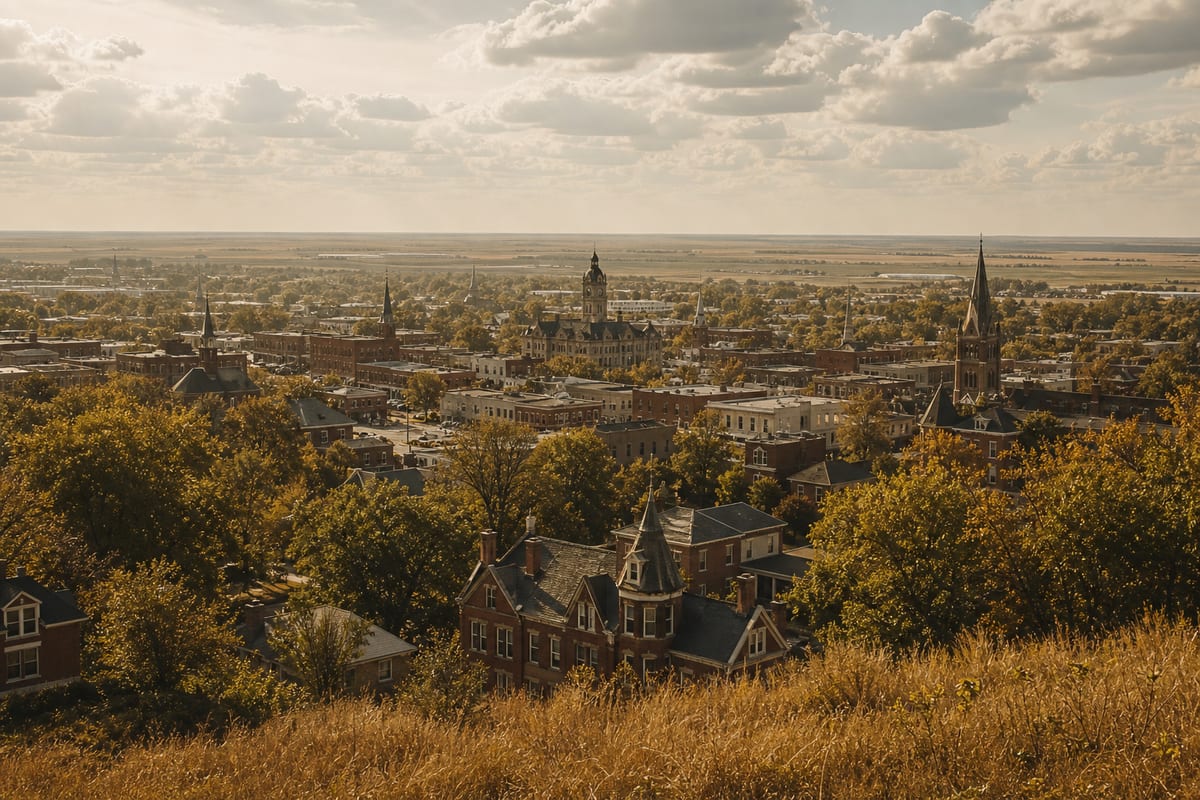
Paola 150 Years: A Complete History of Kansas's Oldest County Seat
Paola, Kansas has existed long enough to contain multitudes. The city platted in 1855 on the rolling Osage Plains of eastern Kansas has been, in succession, a frontier outpost caught in the violence of the slavery debate, a Union supply center in the border war, a railroad boomtown, a Progressive Era county seat, a Depression-era agricultural community, a postwar bedroom of the Kansas City orbit, and finally the self-aware historical city that marked its own 150th birthday in 2005. Each of those phases left its sediment in the landscape, the institutions, and the collective memory of Miami County.
The Paola 150 Years series examines that accumulated history in seven parts, organized by era. The approach is roughly chronological, though history rarely observes clean boundaries, and each part necessarily carries traces of what came before. Together the seven installments trace an arc from territorial founding to modern exurb — a span that encompasses the whole of American industrial and post-industrial history.
What Each Part Covers
Part 1: Founding on the Kansas Frontier, 1855–1865 opens the series at Paola’s beginning. The Kansas-Nebraska Act of 1854 opened the territory to settlement under the doctrine of popular sovereignty, meaning that Kansas residents would decide the slavery question for themselves. The result was a competitive rush of settlement by both pro-slavery and free-state factions, and the violence that accompanied that competition earned the territory the name “Bleeding Kansas.” Paola was established in this turbulent environment and survived to become Miami County’s permanent county seat.
Part 2: War, Veterans, and Reconstruction, 1861–1875 covers the Civil War decade and its aftermath. Miami County’s border position — just south of Kansas City, adjacent to Missouri — made it a theater of guerrilla warfare and refugee displacement as well as a source of Union soldiers. The Reconstruction period brought the challenges of economic rebuilding and the establishment of the veterans’ institutions that would shape civic life for the rest of the 19th century.
Part 3: Growth and Commerce in the Railroad Era examines the three decades between Appomattox and the turn of the century, when rail connections transformed Paola from a frontier county seat into a commercially organized small city. The Katy railroad, a prospering agricultural hinterland, and the brick commercial district that rose around the courthouse square define this era.
Part 4: Progress and the World at War, 1900–1920 takes the story into the 20th century. The Progressive Era brought civic reform, improved infrastructure, and the arrival of the automobile. World War I then tested the community’s capacity for collective sacrifice, drawing Miami County men into the European conflict and subjecting the home front to the mobilization demands of modern warfare.
Part 5: Hard Times and Second War, 1920–1945 covers the most turbulent quarter century in Paola’s history. Prohibition reorganized the social landscape. The Great Depression struck Miami County’s agricultural economy with particular force, collapsing farm prices and straining the banks and businesses that served rural communities. World War II then mobilized an entire generation for a second global conflict.
Part 6: Postwar Growth and the Highway Era, 1945–1975 examines the three decades of relative prosperity that followed the war. Returning veterans, baby boom population growth, and the highway infrastructure that connected Paola to the Kansas City metropolitan economy shaped a period of expansion. The social upheavals of the 1960s registered in Paola as they did everywhere, though the rhythms of a small county seat mediated their impact.
Part 7: Toward the Sesquicentennial, 1975–2005 brings the series to its close at Paola’s 150th birthday. The final decades of the 20th century saw the city’s identity shift as metropolitan growth pushed residential development deeper into Miami County. Paola navigated the tensions between preservation and growth, between its agricultural heritage and its suburban future, arriving at the sesquicentennial with both its history and its momentum intact.
A Note on Sources
The history of Paola and Miami County is documented in the records held by the Miami County Historical Society, the holdings of the Kansas Historical Society in Topeka, and the newspaper archives of the Miami County Republic and its predecessors, which have covered the county seat community since the 19th century. County histories published in 1881 and 1898 provide contemporary accounts of the founding and railroad eras. Federal census records, military service files, and land transaction records supply the demographic and economic detail that animates the institutional narrative.
The series draws on this documentary record to reconstruct the experience of a city that has been present, continuously, through 150 years of American history. Paola in 2005 stood on ground that had been a county seat for a century and a half — long enough for the layers of its past to constitute a genuine depth of local history, and long enough for the community to look back with both pride and the honest recognition of how much had changed.