Paola 150 Years, Part 2: War, Veterans, and Reconstruction, 1861–1875
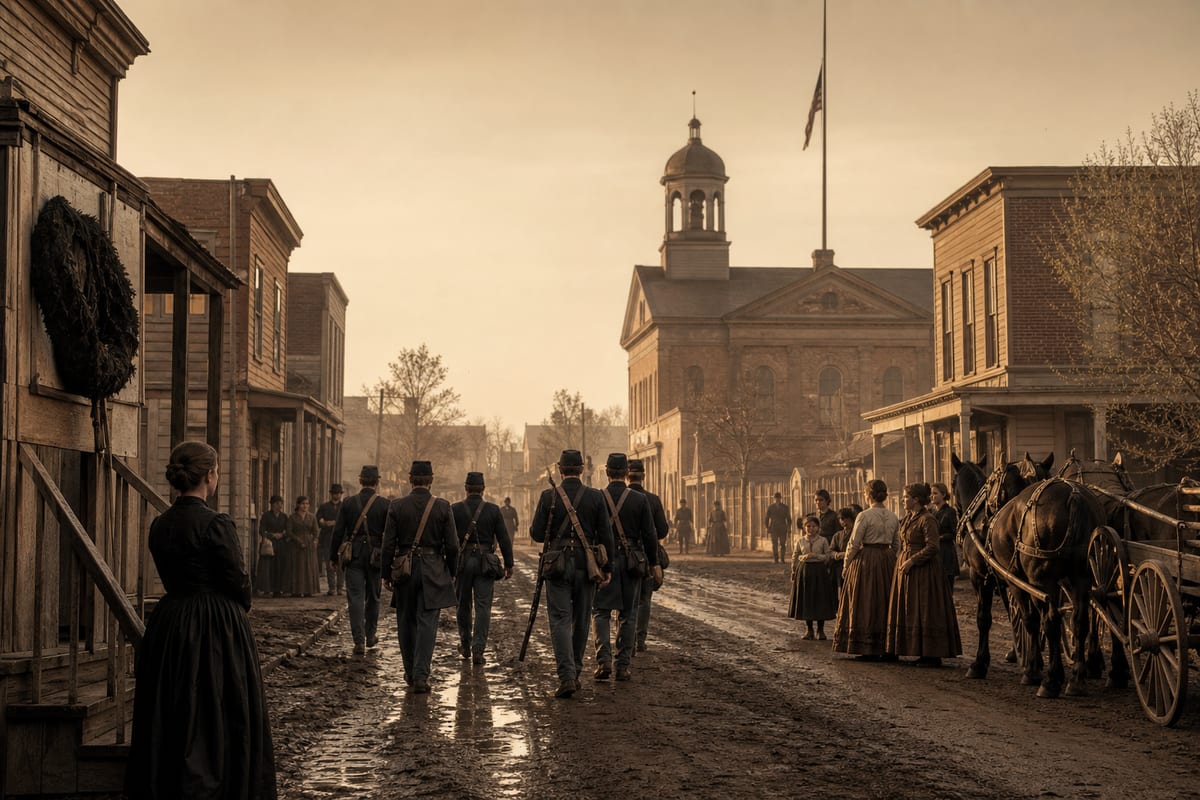
Part 1 of this series traced Paola’s founding in the violent years of the territorial period — the Kansas-Nebraska Act, the settlement conflicts of Bleeding Kansas, and the establishment of the institutional framework that made Paola a functioning county seat by 1860. The city that entered the Civil War in 1861 was small, raw, and still marked by the instabilities of its founding decade. The war years would test it further and leave it, by 1865, with a different kind of stability: the sober, loss-weighted equanimity of a community that had sent its men to a terrible conflict and received them back — those who returned — as veterans.
The Civil War was not an abstraction in eastern Kansas. The border between Kansas and Missouri was an active theater of guerrilla warfare throughout the conflict, and Miami County’s position along that border meant the war arrived in the form of raiding parties, refugee columns, and the constant anxiety of living in contested territory.
Kansas Men in the Union Army
Kansas was admitted to the Union in January 1861, just months before the firing on Fort Sumter, and the new state moved quickly to raise troops. Kansas contributed disproportionately to the Union war effort relative to its population — a product of the state’s deep antislavery commitments and the martial culture developed during the Bleeding Kansas years. The Kansas infantry and cavalry regiments that formed in 1861 and 1862 drew heavily from the county seat communities of eastern Kansas, and Paola and Miami County contributed their share.
Miami County men served in multiple Kansas regiments across the war’s four years. They fought in the western theater, in the trans-Mississippi campaigns, and along the contested Missouri-Kansas border. The names of those who did not return were recorded in the county’s collective memory with the specificity that small communities bring to their losses: a neighbor, a merchant’s son, a farmer’s eldest boy, a young attorney who had just opened his office on the courthouse square.
The county also contributed to the United States Colored Troops. Kansas raised some of the earliest Black regiments in the Union Army, a consequence of the state’s antislavery politics and the presence of Black refugees who had crossed from Missouri seeking freedom. The integration of Black soldiers into the Union war effort was not uncontested even in Kansas, but the state’s record in this respect was significantly better than most.
The Border War at Home
While Miami County men fought in distant theaters, the war came home in the form of guerrilla conflict. The Missouri-Kansas border had been a zone of raiding and retaliation since the Bleeding Kansas years, and the Civil War provided Confederate-aligned Missouri bushwhackers with both motivation and cover for continued operations into Kansas. The raids that terrorized border communities in Kansas during the war years were an extension of the same violence that had marked the territorial period.
William Quantrill’s raid on Lawrence in August 1863 — in which approximately 150 men and boys were killed and much of the town destroyed — was the most catastrophic single event of the border war, but it was not isolated. Smaller raids and skirmishes were a recurrent feature of life in eastern Kansas border counties throughout the conflict. Miami County, positioned to the south of the Lawrence corridor, was not exempt from this threat, and the county’s communities maintained the alert, defensive posture that border proximity required.
The response to guerrilla violence reinforced the military culture already developing in Kansas. Local militia companies, home guard units, and the irregular formations that operated under various state and federal authorizations provided some protection and conducted retaliatory operations across the border. The line between legitimate military activity and reprisal was rarely clear in this warfare, and Miami County residents who lived through the period understood the Civil War as something fundamentally different from the set-piece battles being fought in Virginia and Tennessee.
The Return of the Veterans
The war’s end in April 1865 brought Miami County’s surviving soldiers home across the following months. The community they returned to had changed in ways both visible and subtle. Farms had been managed by women, children, and older men in the absence of young male labor. Businesses had contracted or adapted. Some families had moved away. The county’s politics had been shaped by four years of wartime government, wartime taxation, and the political realignment that the war produced at every level.
The veterans themselves brought the war back with them in ways that shaped Paola and Miami County for the next half century. They organized the Grand Army of the Republic post that would become one of the most influential civic institutions in the county. They ran for office — the GAR’s political mobilization was a defining feature of Kansas Republican politics through the end of the century. They claimed their place in the community’s leadership on the strength of their service, and the community, for the most part, recognized that claim.
The GAR post in Paola became the custodian of Civil War memory for the county. Memorial Day observances, monument dedications, and the annual rituals of veteran commemoration kept the war’s significance alive in public consciousness and gave the veterans a continued civic role long after their active service had ended. The monuments the GAR erected in courthouse squares across Kansas — Paola’s among them — made the war’s sacrifice a permanent feature of the urban landscape.
Reconstruction and Rebuilding
The Reconstruction period following the war — roughly 1865 to 1877 nationally, though its rhythms in Kansas were shaped by the state’s particular circumstances — brought the challenges of economic recovery and institutional development. Miami County had not suffered the physical destruction that marked Reconstruction in the former Confederate states, but it had its own rebuilding to do: farmsteads that had been undermaintained during the war years, businesses that had contracted, institutions that needed consolidation and permanent footing.
The decade after the war saw Paola begin the commercial expansion that would accelerate dramatically with the arrival of the railroad in the early 1870s. New businesses appeared on the courthouse square. Population grew as settlers continued to arrive in eastern Kansas, attracted by land availability and the relative stability of a postwar environment. The brick construction that would come to characterize the railroad era was still largely in the future, but the commercial and civic confidence that would drive that building boom was already taking shape.
The veterans who returned to Paola and Miami County brought the Civil War’s political consequences with them. Kansas Republicanism — rooted in the free-state cause, reinforced by wartime loyalty, and institutionally organized through the GAR — would dominate the state’s politics for generations. The political culture that took shape in Paola during the Reconstruction years was the political culture of a community that had staked its identity on the Union cause and expected to govern itself accordingly.
Part 3 of the Paola 150 Years series takes up the story with the railroad era of the 1870s and 1880s, when the economic transformation that the war had deferred finally arrived — and with it the brick commercial district, the Ursuline educational mission, and the settled character of a Victorian-era Kansas county seat.