Paola 150 Years, Part 7: Toward the Sesquicentennial, 1975–2005
Part 6 of this series traced the postwar decades of growth — the veterans who came home, the baby boom expansion of schools and neighborhoods, and the highway infrastructure that began connecting Paola to the Kansas City metropolitan economy in ways that would prove transformative. By the mid-1970s, Paola stood at the threshold of the most significant change in its demographic character since the railroad era a century before. The city that had been, throughout its history, primarily an agricultural service center and county seat was about to become something more complex: a residential community whose residents had professional and economic lives anchored partly in a metropolitan region 50 miles to the north.
The final three decades of Paola’s first 150 years were a period of negotiation between the city’s historical identity and its emerging suburban present.
The Exurban Transformation
The Kansas City metropolitan area’s residential expansion had been pushing outward from its urban core since the postwar period, following the highway corridors that connected the core to the surrounding countryside. By the 1970s and 1980s, that expansion had reached and then extended through Johnson County, Kansas — the affluent suburban county immediately south and west of Kansas City. As Johnson County’s own land prices and development density increased, the metropolitan frontier continued moving, and Miami County, the next county south along the Highway 169 corridor, began receiving residential development pressure it had not previously experienced.
The newcomers who arrived in Miami County during the 1980s and 1990s were largely not farmers or agricultural workers. They were professionals, managers, and tradespeople whose employment was in Kansas City or its suburbs and who chose Miami County for its lower land costs, its small-city character, and the quality of life associated with a community that had not yet been absorbed into suburban homogeneity. The homes they built in subdivisions on the edges of Paola and in rural areas throughout the county were different from the agricultural farmsteads that had historically defined the county’s residential landscape.
This demographic influx was not without tension. Long-established Miami County families whose identities were rooted in the agricultural economy and the civic culture of the county seat city found themselves sharing community space with newcomers whose primary affiliations were elsewhere. School enrollment increased, putting pressure on facilities and budgets. Traffic on Highway 169 grew. The commercial geography of the community began to shift as the retail patterns of the newcomers — accustomed to suburban shopping centers rather than county seat downtowns — influenced where businesses located.
Downtown Paola and the Preservation Question
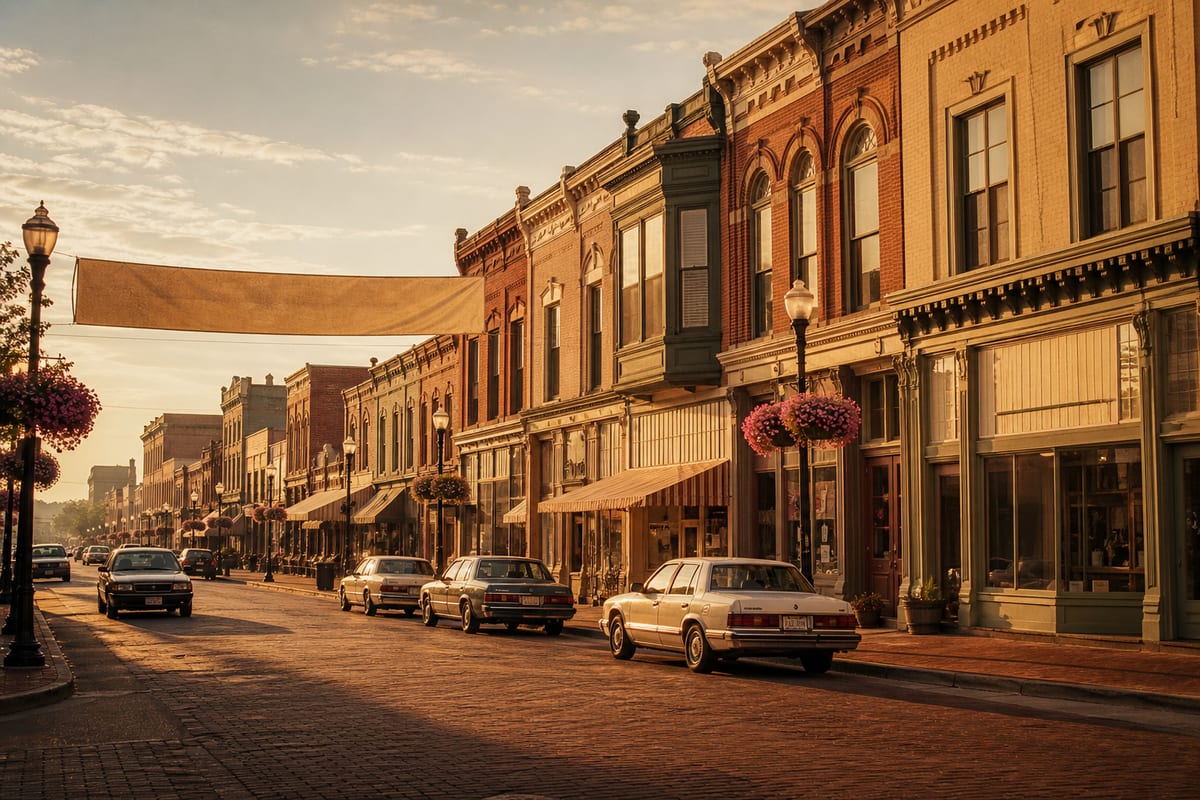
The postwar decades had not been entirely kind to Paola’s downtown commercial district. The same forces that affected small-city downtowns across the country — the shift of retail to automobile-oriented strip developments and shopping centers, the erosion of the captive customer base that had sustained county seat commerce when travel options were limited — weakened the economic foundations of the courthouse square commercial district.
The brick buildings that the railroad era had constructed in the 1870s and 1880s were now a century old, their maintenance histories uneven, their adaptation to contemporary retail and professional uses a genuine challenge. Some structures had been demolished. Others had been altered in ways that obscured their 19th-century character beneath mid-20th-century facade treatments. The courthouse square that had been Paola’s commercial center for a hundred years was under pressure.
The historic preservation movement that emerged nationally in the 1960s and 1970s — institutionalized in the National Historic Preservation Act of 1966 and the federal historic tax credit programs that followed — offered Miami County a framework for addressing the downtown challenge. Historic designation provided recognition, and the associated tax incentives provided financial tools for rehabilitation projects that might not otherwise pencil out economically. Main Street program participation, which Kansas communities could access through the state historic preservation office, offered technical assistance and organizational frameworks for downtown revitalization.
Paola’s engagement with historic preservation reflected the community’s consciousness of its own historical depth. A city that had been a county seat since 1855 — that had experienced the full arc of American 19th and 20th-century development — had architectural and institutional resources that newer communities lacked. The courthouse, rebuilt in the late 19th century, remained the visual anchor of the downtown. The brick commercial buildings that survived from the railroad era provided a physical record of the city’s development. Preserving and activating those resources was both an economic and a civic project.
Civic Identity at 150 Years
The 2005 sesquicentennial arrived at a moment when Paola was navigating these tensions between historical identity and contemporary growth pressure. The community that gathered to mark 150 years of continuous existence was more diverse in its origins and affiliations than the community of 1855 or even 1955. It included families whose roots in Miami County extended to the founding era alongside newcomers whose connection to the county dated to the previous decade. It included farmers and commuters, long-established residents and recent arrivals, people whose sense of Paola was shaped by decades of involvement and people for whom it was simply a pleasant place to live.
The sesquicentennial celebration was, in this context, a deliberate act of community self-examination. The historical exhibitions, public programs, and retrospective publications that marked the anniversary asked residents to understand their city in relation to its full 150-year development — to see the courthouse square not just as a current commercial center but as the site of a continuous civic life stretching back to the Kansas Territory. The Miami County Historical Society, the schools, civic organizations, and local government all contributed to the commemoration.
What the sesquicentennial documented was a city that had outlasted the frontier conditions of its founding, the violence of Bleeding Kansas, the Civil War, the agricultural crises of the late 19th and early 20th centuries, the Depression, two world wars, and the structural transformation of the American economy that had emptied many similar communities across the Great Plains. Paola had survived not through any single advantage but through the accumulated resilience of its institutions, its economic adaptability, and the commitment of successive generations of residents to maintaining the community that their predecessors had built.
The Paola 150 Years series traces that survival across seven eras. The city that reached its sesquicentennial in 2005 was recognizably the descendant of the county seat platted on the Osage Plains in 1855 — carrying its history forward, still the seat of Miami County government, still organized around the courthouse square that the founding generation had established, and still, after 150 years, a functioning community with the resources to look back on its own past with something approaching understanding.