Paola 150 Years, Part 4: Progress and the World at War, 1900–1920
Part 3 of this series traced Paola’s railroad-era transformation — the Katy connection that remade the county’s commercial geography, the brick downtown district that rose around the courthouse square, and the civic and educational institutions that gave the city its Victorian-era character. The turn of the 20th century found Paola as an established county seat city, its commercial foundations solid, its institutional life mature, and its population steady. The first two decades of the new century would not be static. Progressive Era reform movements, the technological disruption of the automobile, and the global catastrophe of World War I would all leave their marks on the community.
The Progressive Era was, in part, a response to the problems that late 19th-century industrialization and urbanization had created in American cities. Its reform energies — directed at corporate power, government corruption, public health, and civic improvement — reached the county seat level with varying intensity, but they arrived in Paola nonetheless.
The Automobile Arrives
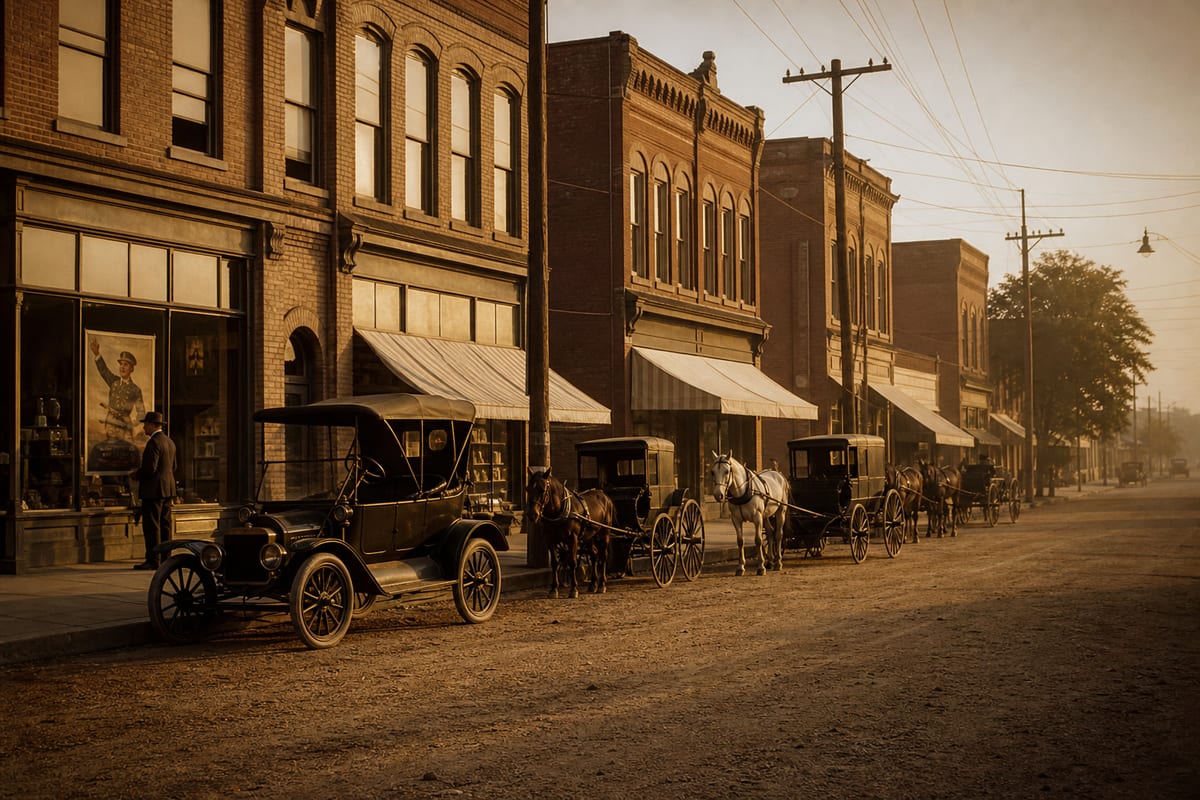
No single technological development did more to transform everyday life in early 20th-century Paola than the automobile. The first cars appeared on Kansas roads in the first decade of the century, curiosities that quickly became necessities as their practical utility became apparent. By 1910 the automobile was no longer a novelty; by 1920 it had restructured the basic geography of commerce and social life across the county.
For a community like Paola, the automobile’s effects were layered and sometimes contradictory. The car extended the commercial reach of the county seat by making it accessible to farmers who previously depended on the railroad schedule or the limitations of horse-drawn transport. Residents of outlying rural communities who had organized their lives around the nearest crossroads store or the nearest rail depot now had the option of traveling to Paola for a wider range of goods and services. In the short term, this reinforced Paola’s commercial centrality.
At the same time, the automobile began eroding the captive geography that had protected small-town commerce. The same mobility that brought more Miami County farmers to Paola also, in time, gave them access to Kansas City. The automobile democratized distance, and Paola’s merchants would spend much of the 20th century managing the competitive pressure that this democratization created.
The roads that the automobile required represented a significant civic investment. Miami County’s road network had been built for horse traffic — adequate for its original purpose but unsuitable for year-round automobile use. The push for improved roads, which became a political priority across rural Kansas during the 1910s, produced bond issues, county road programs, and eventually the highway designations that would give Miami County its connections to the regional transportation system. Paola civic leaders understood that road quality was now an economic development question, and the Progressive Era’s faith in public investment provided the ideological framework for government action.
Progressive Reform in Paola
The Progressive Era’s reform energies expressed themselves in Paola through the civic organizations and municipal politics that shaped daily life. Women’s clubs, which had been building institutional capacity since the late 19th century, became vehicles for Progressive-aligned civic campaigns: library funding, public health advocacy, school improvement, and the temperance cause that Kansas had embraced constitutionally in 1880. The Chautauqua movement brought speakers and cultural programming to communities across the region, giving Paola residents access to the national conversation about reform and improvement that the Progressive Era generated.
Municipal government in the Progressive Era faced new expectations. Residents who had accepted minimal public services in the frontier era now demanded water systems, street improvements, electrical infrastructure, and public health administration. Kansas law gave municipalities the authority to invest in these systems, and the Progressive-Era faith in government competence provided political justification for public ownership of utilities. Paola’s expansion of municipal services during this period reflected both the genuine infrastructure needs of a growing city and the ideological moment that made public investment seem practical and appropriate.
Kansas prohibition, which had been constitutional law since 1880, remained an active enforcement challenge through the Progressive Era. The Women’s Christian Temperance Union and the Anti-Saloon League maintained pressure on county and municipal officials to enforce the liquor laws, with mixed results. Miami County’s proximity to Missouri — where liquor was legal — complicated enforcement and sustained a market for illegal alcohol that would become more visible after national Prohibition arrived in 1920.
World War I and the Miami County Response
The United States entered World War I in April 1917, and the federal mobilization that followed reached into every Kansas county. The Selective Service Act of May 1917 established the draft system through which Miami County men were registered, classified, and called to service. Local draft boards — civilian bodies administering a federal system — made the life-altering decisions about who would serve and who would be deferred, a responsibility that fell heavily on the prominent citizens appointed to those positions.
Miami County men served in Kansas National Guard units federalized for the war and in the regular army formations that the draft filled. They went to training camps in the American South and Midwest before shipping to France as part of the American Expeditionary Forces. The AEF’s combat service in 1918 — in the Meuse-Argonne offensive and along the Western Front — cost Miami County a portion of the young men who had registered and gone.
The home front experience of World War I was organized around the demands of the federal government and the volunteer mobilizations that supplemented federal programs. Food conservation drives — the Hoover-directed program that asked American families to observe meatless and wheatless days — were administered through local committees in communities like Paola. War bond drives organized the county’s financial contribution to the war effort. Red Cross chapters stitched bandages and assembled care packages.
The 1918 influenza pandemic reached Kansas in the fall of that year, striking communities across the state as the AEF’s returning soldiers and the movement of wartime workers spread the virus through the population. Miami County’s experience mirrored the national pattern: a sudden overwhelming of the available medical resources, deaths concentrated among the young adults whose immune systems responded to the novel virus with fatal intensity, and a community grief layered on top of the wartime losses already being absorbed. The pandemic’s human cost was significant, though overshadowed in public memory by the more legible drama of the war itself.
A Community Transformed
By 1920, Paola had absorbed two decades of change that its founders could not have anticipated. The automobile had restructured commerce and daily mobility. Progressive reform had reshaped expectations of municipal government. World War I had taken the community’s young men to a European battlefield and brought back those who survived with a set of experiences that would shape the next two decades of civic and political life.
The veterans of World War I did not build the same kind of institutional presence that the Civil War veterans had created through the GAR, but they entered a community already shaped by veteran culture and added their generation’s particular experience to it. The American Legion post that Paola’s WWI veterans organized became a fixture of civic life in the interwar years.
Part 5 of the Paola 150 Years series takes up the story in the 1920s — beginning with the contradictions of the Prohibition decade, moving through the devastation of the Great Depression, and ending with the mobilization of another generation for another world war.