The Patterson Circus and Miami County, Kansas
In the late 19th and early 20th centuries, the arrival of a traveling circus in a small Kansas town was an event unlike almost any other in the annual calendar. For a community like Paola — the county seat of Miami County, some fifty miles south of Kansas City — a circus visit transformed the ordinary rhythms of market-town life into something extraordinary for a day or two. The Patterson Circus was among the traveling shows that made its way through the region during this era, and its connection to Miami County is documented in local historical records.
American Traveling Circuses in the 19th Century
The traveling circus reached its first great period of American popularity in the decades following the Civil War. Before the war, circuses moved primarily by wagon, following rutted roads between market towns and requiring weeks to cover distances that later became manageable in days. The expansion of the railroad network after 1865 transformed the economics of the circus industry. Entire shows — canvas tents, animal cars, performer wagons, and all the infrastructure of a traveling entertainment operation — could be loaded onto specially designed railroad flatcars and moved overnight from one town to the next.
This logistical revolution allowed circuses to grow in scale and ambition through the 1870s and 1880s. The largest operations assembled dozens of railroad cars and employed hundreds of workers, presenting programs that drew on performers recruited from across the United States and from Europe. The names that dominated the era — Barnum, Bailey, Ringling — eventually consolidated into a handful of major enterprises, but throughout this period many smaller and mid-sized circus operations also toured the country, filling the gaps in the schedules of the major shows and reaching towns that the largest companies bypassed.
The Patterson name was carried by several circus enterprises during these years. The circus industry of the 19th century was a world of partnerships, reorganizations, and rebranded operations, and a name like Patterson could appear on a circus wagon through the efforts of different promoters and managers across different decades. What connected these operations was the tradition of the traveling show itself: the big top, the menagerie, the parade, and the promise of spectacle that arrived on schedule and departed just as punctually.
Advance Men and the Circus Parade
Weeks before a circus appeared in a town like Paola, the advance work had already begun. Circus companies employed teams of bill posters and advance agents whose job was to saturate a town and its surrounding countryside with advertising. They plastered lithographed posters on the sides of barns, on the board fences of vacant lots, on the walls of warehouses and feed stores. These posters — often richly illustrated with lions and acrobats and exotic imagery — served as the first visual announcement of the circus’s approach.
By the day of the performance, the town would be papered so thoroughly with circus advertising that residents and farmers arriving from the surrounding countryside could not have missed it. Newspapers carried additional notice. In an era when entertainment options were limited and most rural families rarely traveled far from home, the circus represented a convergence of novelty, color, and spectacle that the daily round of agricultural life could not provide.
The circus parade through the main street of a town was itself a performance, a free preview designed to generate excitement and draw every possible customer toward the show grounds. Wagons elaborately carved and gilded, their panels painted with scenes of distant lands and wild animals, rolled through the streets. Elephants walked in file. Brass bands played. Acrobats and costumed performers rode on decorated floats. For the children who lined the boardwalks of Paola’s main street, and for the farmers who had driven in from the surrounding townships of Miami County, the parade was a condensed vision of a world far beyond the Osage Plains.
Circus Grounds and Show Day
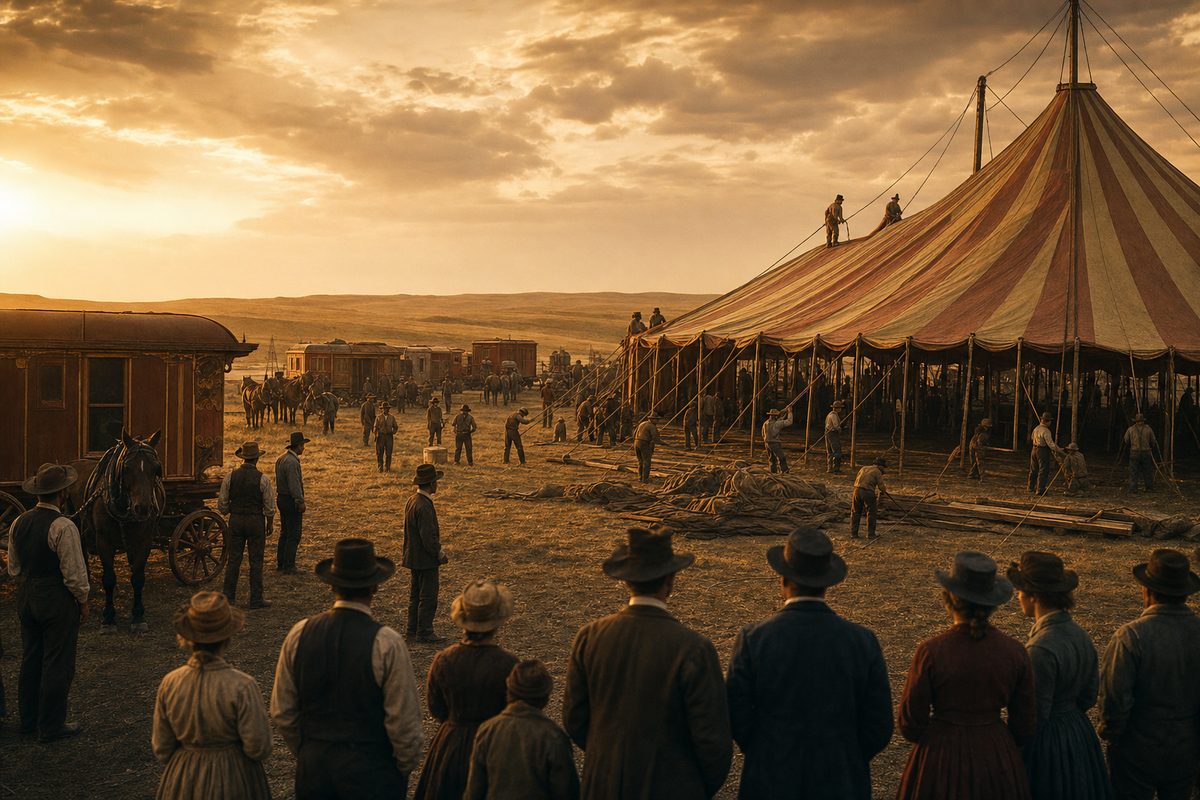
The circus set up on whatever open ground was available at the edge of town — a fairground, a field, a vacant lot large enough to accommodate the main tent and its surrounding operations. The big top itself could seat thousands of spectators under its canvas expanse, supported by a forest of poles and rigging. Around it clustered the menagerie tent, where exotic animals could be viewed before the performance, and the sideshow tent, which offered its own roster of unusual performers and curiosities.
Show day in a county-seat town like Paola was also an economic event. Farm families who had driven in for the circus combined the excursion with supply purchases, banking errands, and visits to relatives in town. Merchants on the courthouse square benefited from the influx of customers. The circus itself employed a small army of local workers for the setup and teardown — roustabouts, stake drivers, ticket takers — who earned wages that briefly circulated through the local economy.
The performers who appeared under the big top represented the circus industry’s recruitment network, which extended across national and international lines. Aerialists, acrobats, equestrians, clowns, and animal trainers came from backgrounds as varied as the countries that supplied European circus traditions. The animals — elephants, lions, tigers, bears, zebras, camels — were themselves products of a global trade in exotic wildlife that the circus industry helped to sustain throughout the 19th century.
The Patterson Circus in Miami County
The Patterson Circus’s documented connection to Miami County places it within this broader pattern of traveling entertainment that moved through eastern Kansas during the late 19th and early 20th centuries. Local historical records and newspaper accounts from Miami County reference circus visits that registered as significant events in the community life of the region. For residents of Paola and the surrounding townships, the appearance of the Patterson Circus on the show grounds represented one of the few occasions each year when the outside world arrived in concentrated form.
The specific routing decisions that brought a circus like the Patterson organization to Miami County reflected the practical geography of the touring circuit. Paola’s position on the rail network and its status as the county seat, drawing residents from across Miami County’s townships on market days and court days, made it a logical stop for a traveling show seeking the densest possible audience within a single community. The railroad connection meant that a circus could arrive, perform, and depart with the efficiency that made the touring model economically viable.
Historical documentation of circus visits in county newspapers of this era typically recorded not just the fact of a visit but something of the community response. A circus day in a small county seat was the kind of occasion that local editors noted, and the accounts that survived in newspaper files and in the memories recorded by local historians offer a window onto the social texture of these events.
The Decline of the Traveling Circus
The golden age of the American traveling circus extended roughly from the late 1860s through the first decade of the 20th century. By the 1910s and 1920s, the forces that would eventually bring down the touring circus model were already gathering. Motion pictures offered a form of entertainment that was permanent, inexpensive, and available in any town large enough to support a movie house. Radio broadcasting began delivering entertainment directly into farm homes across Kansas and the rest of the country. The automobile, by expanding the radius within which rural families could travel for entertainment, paradoxically undermined the business model of the circus — which depended on being the only spectacle within reach.
The larger circus enterprises consolidated and adapted through the early 20th century. The Ringling Brothers and Barnum and Bailey Circus, formed through mergers of the industry’s dominant players, continued to operate on a reduced basis well into the mid-20th century. But smaller and mid-sized operations like those that had carried the Patterson name found the economics increasingly unfavorable. Rising costs, competition, and the shifting habits of American audiences made the touring model difficult to sustain.
The circuses that had visited towns like Paola in the 1880s and 1890s were products of a specific moment in American cultural history — a period when rural communities were largely dependent on the occasional arrival of traveling entertainment for relief from the isolation and repetitiveness of agricultural life. That moment passed, and with it passed the annual occasion that had briefly turned the show grounds at the edge of town into a portal to a more vivid world.
The Circus in Miami County Memory
What the Patterson Circus left behind in Miami County was memory, and through memory, historical documentation. The circus visits that registered in local newspaper accounts, in family recollections passed down through generations, and in the local history records preserved at the Kansas State Historical Society are fragments of a social history that encompasses far more than entertainment. They speak to the hunger for novelty and spectacle that was a natural feature of rural life, to the economic and social rhythms of a county-seat community, and to the networks of commerce and culture that connected a county like Miami County to the broader American world of the late 19th century.
That the Patterson Circus should leave its mark in the historical record of a Kansas county is not surprising. What is notable is that the record survived — in newspaper files, in local histories, in the citations that eventually made their way into encyclopedic sources. These traces of a circus day in Paola are also traces of what daily life in Miami County looked like in an era that is now more than a century removed from the present. Other stories from that era of local life survive in accounts such as Miss Flora, another chapter of Miami County’s local history preserved in historical records.