Paola 150 Years, Part 3: Growth and Commerce in the Railroad Era
The Paola 150 Years series traces the city’s development across a century and a half of change. Part 1 examined the founding era — the Kansas-Nebraska Act, the arrival of the first settlers in 1855, and the violent years of Bleeding Kansas that preceded statehood. Part 2 covered the Civil War decade, when Miami County’s border position drew the county into guerrilla conflict and the human costs of the slavery question were paid in full. This third installment takes up the story where the war’s end left it: a county seat city with its institutions intact, its population growing, and a new era of economic development about to begin.
The three decades between Appomattox and the turn of the 20th century were the period in which Paola became, in the fullest sense, a functioning American small city. The railroad made that transformation possible.
The Missouri, Kansas and Texas Railway
Before the railroad, Paola’s commercial reach was limited by the physics of overland transport. Grain and livestock moved by wagon to river landings or to railheads elsewhere in the region, absorbing costs and time that eroded the profit margins of Miami County farmers. Markets in Kansas City were accessible but not reliably so. The infrastructure of a modern agricultural economy — grain elevators, livestock yards, a reliable mail service, manufactured goods flowing inward against agricultural commodities flowing out — could not take full shape without rail.
The Missouri, Kansas and Texas Railway, universally known by its nickname the “Katy,” was among the first rail lines to push southward through eastern Kansas in the early 1870s. The Katy’s construction was an event of regional significance. It was the first railroad to enter Indian Territory from Kansas, following a route that brought it through or near the communities of eastern Kansas that depended on agricultural shipping. Its presence in the Paola area connected the city and Miami County to the broader rail network that linked the Great Plains to the markets and manufacturing centers of the eastern United States.
The practical effects were immediate. Freight rates fell relative to wagon transport. Goods available only through slow and expensive overland supply chains became accessible at competitive prices. Farmers who had weighed the costs of expanding production against uncertain shipping capacity now had a more reliable calculation to make. The railroad era in Miami County began as a commercial revolution, and Paola — as the county seat and its largest community — stood at the center of that change.
Additional rail connections followed as the regional network expanded through the 1870s and 1880s. The competition between rail lines for traffic through productive agricultural territory worked to Paola’s advantage, as competing carriers sought to capture the county’s grain and livestock business. Paola acquired the layered rail access that characterized the more prosperous Kansas county seats of the period, and that access reinforced the city’s position as the commercial hub for the surrounding agricultural communities.
Agriculture and the Market Economy
The railroad made Miami County’s agricultural output competitive in distant markets, and the farmers of the county responded by expanding production. Wheat and corn were the dominant cash crops, suited to the county’s fertile Osage Plains soils and the seasonal rhythms of the region’s climate. Livestock — particularly hogs and cattle — complemented the grain economy, consuming the corn that could not be shipped economically and converting it into a more valuable, more easily transported commodity.
Grain elevators rose along the rail lines through Miami County in the 1870s and 1880s, their vertical forms marking the points where the agricultural hinterland connected to the commercial network. The elevator business was itself a form of rural industry, requiring capital investment, operating expertise, and connections to distant commodity markets. The grain trade drew Paola into the speculative rhythms of the Chicago Board of Trade and the Kansas City grain exchanges, linking a county seat of a few thousand people to the price signals of the national economy.
Livestock yards and shipping facilities at Paola’s rail depots handled the cattle and hog traffic that moved through the county’s farms. The Kansas City stockyards — expanding rapidly in the 1870s and 1880s to handle the cattle drives from the southern plains and the hog production of the Midwest — were the destination for much of Miami County’s animal output. Rail access made that connection economically viable in a way that earlier overland routes had not.
The agricultural prosperity of the railroad era was real, if uneven. Years of good prices and favorable weather produced visible wealth — in the brick commercial buildings going up around the courthouse square, in the construction of substantial farmhouses replacing earlier temporary structures, in the expansion of the county’s school and church building stock. But the agricultural economy of the period was also subject to the price collapses and weather extremes that would culminate in the farm crisis of the 1890s, and Miami County farmers experienced that volatility alongside the prosperity.
The Downtown Commercial District
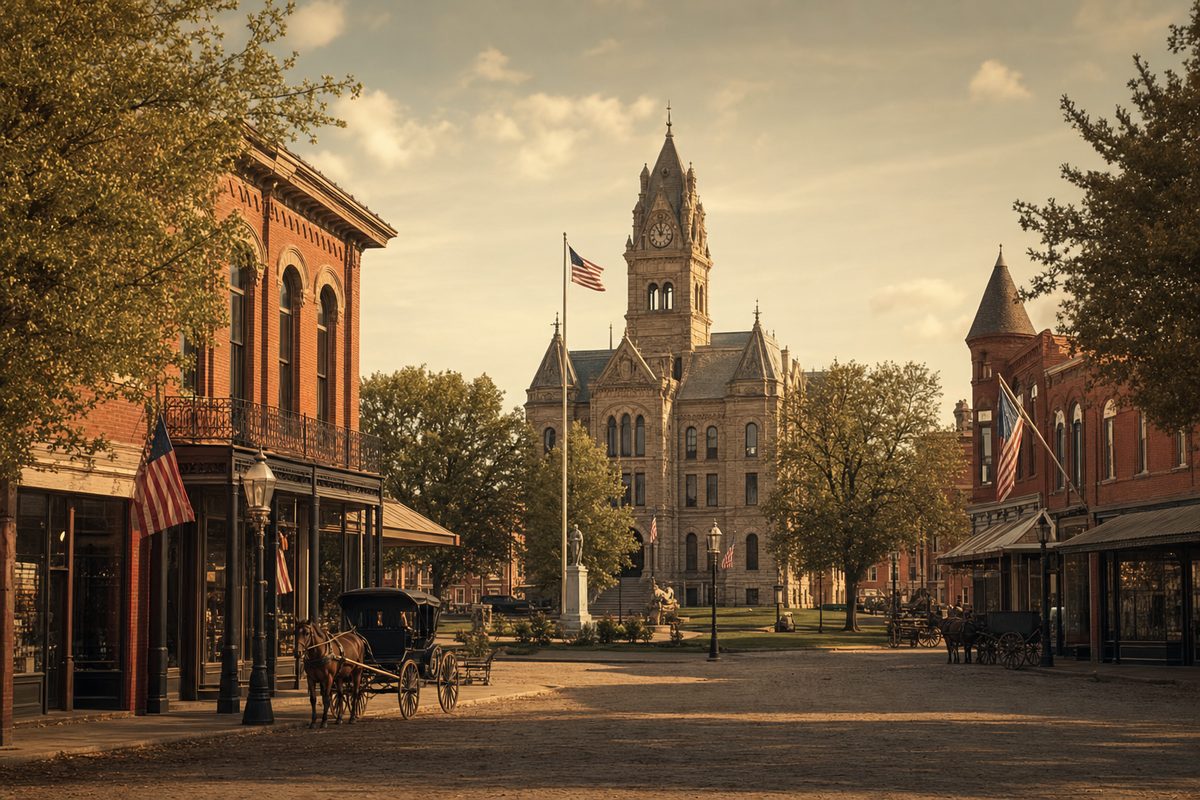
The most visible product of railroad-era prosperity was the transformation of Paola’s downtown. The wooden frame buildings of the founding era — practical but impermanent — gave way through the 1870s and 1880s to brick commercial structures that conveyed stability and investment. The courthouse square, which had been the civic center of the county from the beginning, became ringed with the storefronts, professional offices, banks, and hotels that defined the commercial life of a Victorian-era Kansas county seat.
General merchandise stores anchored the retail economy. In the pre-railroad era, such stores necessarily carried a limited range of goods; the difficulty of supply constrained selection. Rail access changed that arithmetic, and the general stores of the 1870s and 1880s offered their customers manufactured goods from eastern factories, processed foods, textiles, hardware, and specialized equipment that would have been difficult to obtain a generation earlier. As the market grew, specialization followed. Hardware stores, dry goods merchants, and drug stores emerged to serve the segments of a retail economy that had grown large enough to support dedicated establishments.
Hotels occupied a significant place in the commercial geography of a county seat town. Court terms drew litigants, lawyers, and witnesses from across the county. County business brought farmers and landowners to the courthouse on a regular basis. The railroad brought commercial travelers — the “drummers” who carried samples and order books for manufacturers and wholesalers — on regular circuits through the region. Paola’s hotels served this transient population and provided the social infrastructure for the business dealings that required face-to-face meetings in an era before telephone communication was widespread.
Banks were essential to the commercial economy of the railroad era. The expansion of agricultural production required credit — for land purchases, for equipment, for seed and livestock. Merchants needed working capital to carry their inventories through the seasonal rhythms of rural trade. Building construction required financing. The local banks that emerged in Paola during the 1870s and 1880s served as the intermediaries between the capital markets of the East and the credit needs of Miami County, performing a function that was as much civic as financial.
Law offices concentrated around the courthouse, as they had since the founding era. The expansion of commercial activity in the railroad period generated new legal work — contracts, property transactions, business disputes, estate administration — that sustained a professional class of attorneys whose careers were intertwined with the growth of the local economy. The courthouse square as a commercial and professional district reflected this dual character: government at its center, commerce and the professions arranged around it.
The Courthouse Rebuilt
Miami County’s courthouse had served the county since the founding era, but the growth of the railroad period created pressure for a more substantial facility. The county government of the 1870s and 1880s administered a more complex and populous jurisdiction than the county of the 1850s had been, and the original courthouse facilities were strained by the volume of records, the frequency of court terms, and the need to project the county’s institutional maturity to a wider audience.
The late 19th century saw Miami County invest in a courthouse that matched its ambitions. The brick structure that replaced earlier buildings on the central square reflected the architectural vocabulary of the period — the Italianate and Romanesque Revival styles that characterized civic architecture across the Midwest in the decades after the Civil War. Masonry construction was a statement: the county intended to endure, and its principal public building expressed that intention in material form.
The courthouse that resulted from this investment became the defining architectural landmark of Paola’s downtown, a visual anchor around which the commercial district organized itself and through which the county’s residents understood their civic identity. It housed the courts, the land records, the tax rolls, and the offices of elected county officials — the full apparatus of local government in a period when that government was the primary institutional presence in most residents’ daily lives.
The Ursuline Sisters and Catholic Education
Among the most consequential developments of Paola’s railroad era was the arrival and growth of the educational institutions established by the Ursuline Sisters. The Ursulines — a Roman Catholic religious order with centuries of educational tradition behind them — came to Paola in the 1870s as part of a broader expansion of Catholic institutional life across the American Midwest. Their arrival reflected the growth of Catholic immigrant communities in eastern Kansas, drawn primarily from Irish and German backgrounds, who required the schools and parishes that the Church had built in the cities of the East and now extended to the frontier.
The school the Ursulines established in Paola served students from across Miami County and the surrounding region. At a time when public education remained inconsistent in quality and coverage across rural Kansas, the Ursuline school offered a structured curriculum delivered by trained and committed teachers. The institution’s standards attracted families who might not otherwise have had access to formal secondary-level education, and its graduates entered the professional and civic life of the county carrying the marks of a serious education.
The significance of the Ursuline presence extended beyond the school itself. The order’s commitment to education for women was particularly meaningful in a period when girls and young women faced substantial barriers to formal schooling beyond the elementary level. The Ursuline school in Paola made that education available to generations of Miami County daughters, and the effects of that access accumulated over decades in the professional accomplishments and community contributions of its alumnae.
The broader Catholic community in Paola grew alongside the Ursuline educational mission. Parish life organized around the institutions the Sisters had established, and the physical presence of Catholic churches and school buildings gave the Catholic community a permanent place in Paola’s architectural and civic landscape. The denominational complexity that resulted — Catholic institutions alongside the Protestant congregations of the founding era — gave Paola the layered religious character typical of growing American cities in the late 19th century.
Civic Organizations and Social Life
The railroad era brought not only commercial prosperity but also the expansion of the civic and social institutions that defined community life in Victorian-era America. Fraternal organizations, civic clubs, churches, and voluntary associations proliferated in Paola during the 1870s, 1880s, and 1890s, creating a dense web of organizational life that structured the social world of the city’s residents.
The Masons and the Independent Order of Odd Fellows were among the most widely distributed fraternal orders in 19th-century America, and Paola had active lodges of both. These organizations provided their members with networks of mutual support, social connection across class lines, and a ceremonial life that carried symbolic weight in a period before mass entertainment had homogenized leisure activity. Lodge membership was a marker of respectability and civic standing, and the lodges’ meeting halls were significant nodes in the social geography of the downtown.
The Grand Army of the Republic — the veterans’ organization for Union soldiers — had an active post in Paola, as it did in virtually every Kansas community large enough to have sent men to the war. The GAR posts of the late 19th century were among the most politically influential organizations in Kansas, their veteran membership base translating into real electoral power. In Paola and Miami County, GAR members shaped local politics and kept the memory of the Civil War — and the county’s part in it — alive in public consciousness through Memorial Day ceremonies, monument dedications, and the annual rituals of veteran commemoration.
Women’s organizations performed analogous social functions. Church auxiliaries, missionary societies, and literary clubs provided women with organizational lives outside the domestic sphere and with vehicles for collective action on civic and charitable projects. The Women’s Christian Temperance Union was among the most active women’s organizations in late 19th-century Kansas, reflecting the temperance movement’s particular strength in a state that would vote for constitutional prohibition in 1880. In Paola, as elsewhere in eastern Kansas, these women’s organizations shaped the moral and civic culture of the community in ways that outlasted the specific causes of the period.
Public Education and the School System
Public education expanded significantly in Paola during the railroad era. The founding generation had established schools as early as the territorial period, but those early institutions were modest in scope and erratic in continuity. The growth of the city’s population and tax base in the 1870s and 1880s created the financial conditions for a more systematic public school system, and the period saw the construction of dedicated school buildings and the expansion of the curriculum beyond the elementary basics.
Kansas law required each district to maintain a public school, and the railroad-era prosperity allowed Paola’s school district to build facilities that expressed the community’s commitment to education. The school buildings constructed during this period were among the most substantial civic structures in the city outside the courthouse, their architecture reflecting the Victorian belief that the form of public buildings communicated the seriousness of their purpose.
The school system that took shape in Paola during the railroad era became the foundation on which the public education institutions of the 20th century would build. Teachers, curricula, and the physical infrastructure of school buildings — all established during this formative period — defined the character of public education in the city for generations.
Toward the Turn of the Century
By the 1890s, Paola had achieved the settled character of a functioning small city. The commercial district around the courthouse square was established in brick and mortar. The professional class — lawyers, doctors, bankers, newspaper editors — had developed the institutional weight that came with decades of continuous practice. The churches and schools and fraternal organizations that gave the community its social texture were operating in permanent facilities. The railroad connections that made the whole economy function were woven into the daily rhythms of commercial life.
The 1890s brought challenges that tested that stability. The agrarian depression of the early part of the decade — driven by falling commodity prices and tightening credit — squeezed Miami County’s farmers and the merchants and bankers whose livelihoods depended on agricultural prosperity. The Populist movement drew support from Kansas farmers who blamed railroad corporations, eastern banks, and the deflationary gold standard for their difficulties. Paola and Miami County were not immune to the political upheaval that produced the People’s Party and sent Populist candidates to Congress and the statehouse in the early 1890s.
The depression eased by the latter part of the decade, and the return of better times allowed Paola to consolidate the gains of the railroad era and begin looking toward the 20th century with a measure of confidence. The city that entered 1900 was recognizably the product of the preceding three decades: commercially organized, institutionally mature, architecturally established, and positioned — through its railroad connections and county seat status — as the durable center of Miami County’s civic and economic life.
Part 4 of the Paola 150 Years series takes up the story at the turn of the 20th century, tracing Paola’s development through the automobile era, the Depression, and the postwar decades that shaped the modern city.