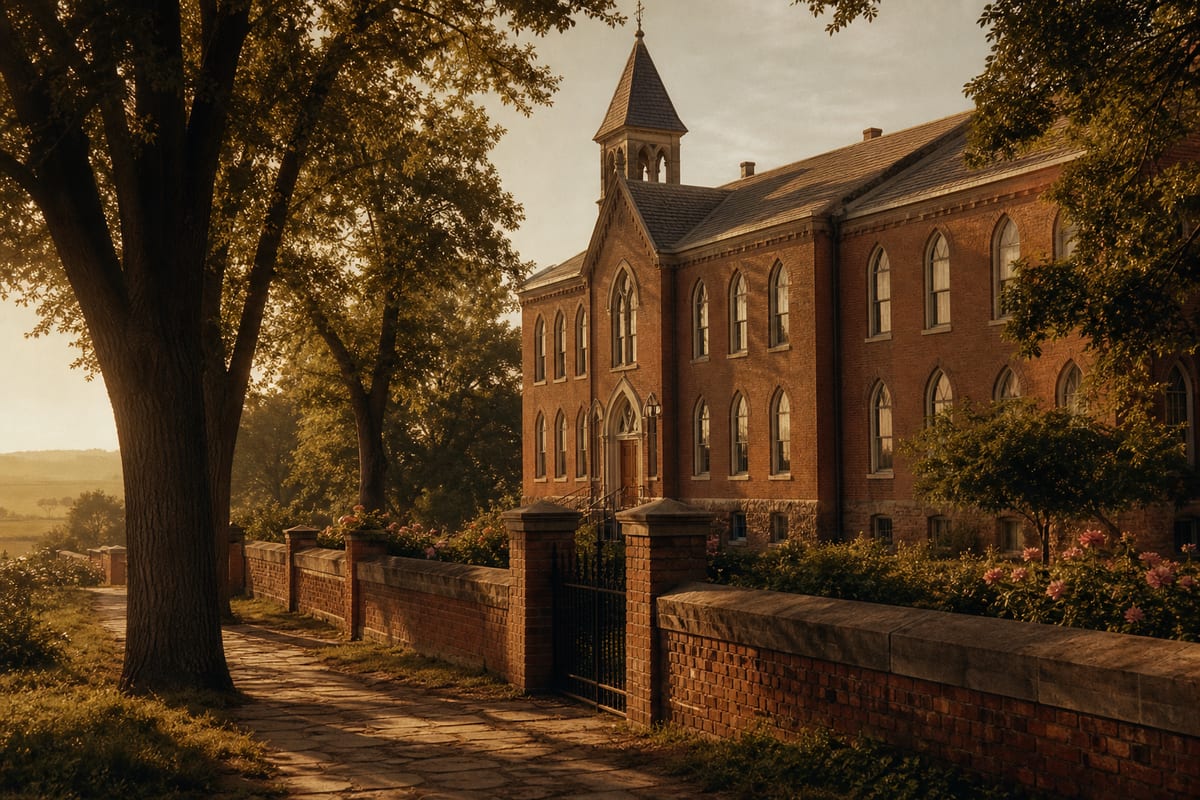
The Ursuline Sisters in Paola, Kansas
An Order Founded for Education
The Ursuline Sisters who arrived in Paola, Kansas in the 1870s carried with them a tradition of educational ministry more than three centuries old. The Order of Saint Ursula — the Ursulines — was founded in Brescia, in northern Italy, in 1535 by Angela Merici, a laywoman who assembled a community of women dedicated to the Christian education of girls. The founding commitment to education — specifically the education of women and girls who would otherwise lack access to formal instruction — remained the order’s defining mission through the centuries.
The Ursulines spread from Italy into France and, through the French colonial network, into North America. The first Ursuline foundation in the Americas was established in Quebec City in 1639, making the order among the earliest organized women’s religious communities in the New World. By the mid-nineteenth century, Ursuline communities were operating schools in Louisiana, Ohio, Texas, and New York, among other states — prepared, in other words, to extend their educational mission into the rapidly developing frontier of the American Midwest.
The Catholic Frontier in Kansas
The arrival of the Ursulines in Paola was part of a broader Catholic institutional response to the rapid settlement of Kansas following the Kansas-Nebraska Act of 1854. The Catholic Church in the United States, led in Kansas by the Diocese of Leavenworth, worked systematically to establish parishes, schools, and religious institutions in the new settlements appearing across the eastern part of the state.
The Catholic population of Miami County in the 1870s was a mix of immigrant communities and native-born Americans whose migration patterns had carried them westward. Irish Catholic immigrants, many arriving in the wake of the Famine years, settled in eastern Kansas as laborers on the railroads and then as farm families once the lines were complete. German Catholic immigrants arrived in organized community groups and established parishes that conducted services in their native language well into the twentieth century.
These immigrant Catholic communities needed institutions: parishes where sacraments could be received, schools where children could be educated in both academic subjects and Catholic religious formation. The diocese looked to religious orders — women’s orders for schools — to provide the institutional capacity that the frontier required. The Ursuline Sisters were among the congregations recruited for this mission.
Arrival and Educational Work in Paola
The Ursuline Sisters’ establishment in Paola in the 1870s placed them at the seat of Miami County’s Catholic institutional development. The school they established provided education at a time when the public school system in Kansas, though legally mandated, was still building its physical and institutional infrastructure. The common schools of rural Kansas in the 1870s were often one-room operations with limited instructional resources. The Ursuline school offered a more structured curriculum, longer terms, and the resources that a religious community with a three-century institutional tradition could provide.
The school served both Catholic and non-Catholic students in its early decades — a pattern common to parochial schools on the frontier, where the alternatives were sparse enough that non-Catholic families sometimes chose Catholic schools for the quality of instruction rather than the religious affiliation.
The curriculum the Ursulines offered reflected both the standard academic subjects of the period — reading, writing, arithmetic, geography, and history — and the specifically Catholic elements of religious education. Music was a particular Ursuline educational specialty. Piano and vocal instruction were standard components of Ursuline school programs wherever the sisters established themselves in the United States, and the Paola school was no exception.
Immigrant Communities Served
The Catholic communities the Ursulines served in Miami County were linguistically and culturally diverse. The German-speaking Catholic parishes of the county conducted their worship and community life largely in German through the late nineteenth century, and the children of these communities arrived at school with varying degrees of English-language fluency. The Irish Catholic families carried the specific cultural heritage of Irish Catholicism with its particular devotional emphases.
The Ursuline tradition, rooted in communities that had operated across multiple national and linguistic contexts since the order’s founding in sixteenth-century Italy, was not unequipped for this challenge. The sisters adapted their instruction to the linguistic realities of their students while maintaining the academic and religious standards the order’s educational mission required.
Beyond the classroom, the Ursulines functioned as community anchors for the Catholic population of Paola and the surrounding county. Religious ceremonies, sodalities, and the rhythms of the liturgical year gave the Catholic community a shared calendar that the sisters helped sustain through their educational and devotional work.
Legacy in Miami County
The Ursuline Sisters’ institutional presence in Paola extended across multiple decades, encompassing generations of students from Miami County families. The cultural formation they provided — the music, the literary tradition, the devotional practices they transmitted — shaped the character of Miami County’s Catholic community in ways that persisted in family traditions and parish culture long after the formal institutional relationship had ended.
Over the course of the twentieth century, the Ursulines’ formal institutional presence in Paola diminished as the public school system matured and as changes within the Catholic Church altered the availability and deployment of teaching sisters. The consolidation and eventual closure of many parochial schools across rural Kansas reflected national trends: as religious communities shrank in membership and as public schools improved in quality, the distinctive advantage that parochial schools had provided in the nineteenth century became less decisive.
The historical record of the Ursuline Sisters’ work in Paola is preserved in diocesan archives, order archives, and the local collections held by the Miami County Historical Society. The order that Angela Merici founded in sixteenth-century Brescia to educate girls who would otherwise remain unschooled found, in nineteenth-century Kansas, a context that matched its foundational mission with remarkable fidelity. The Ursuline Sisters in Paola made a difference that was genuinely consequential — and Miami County’s historical record reflects it.