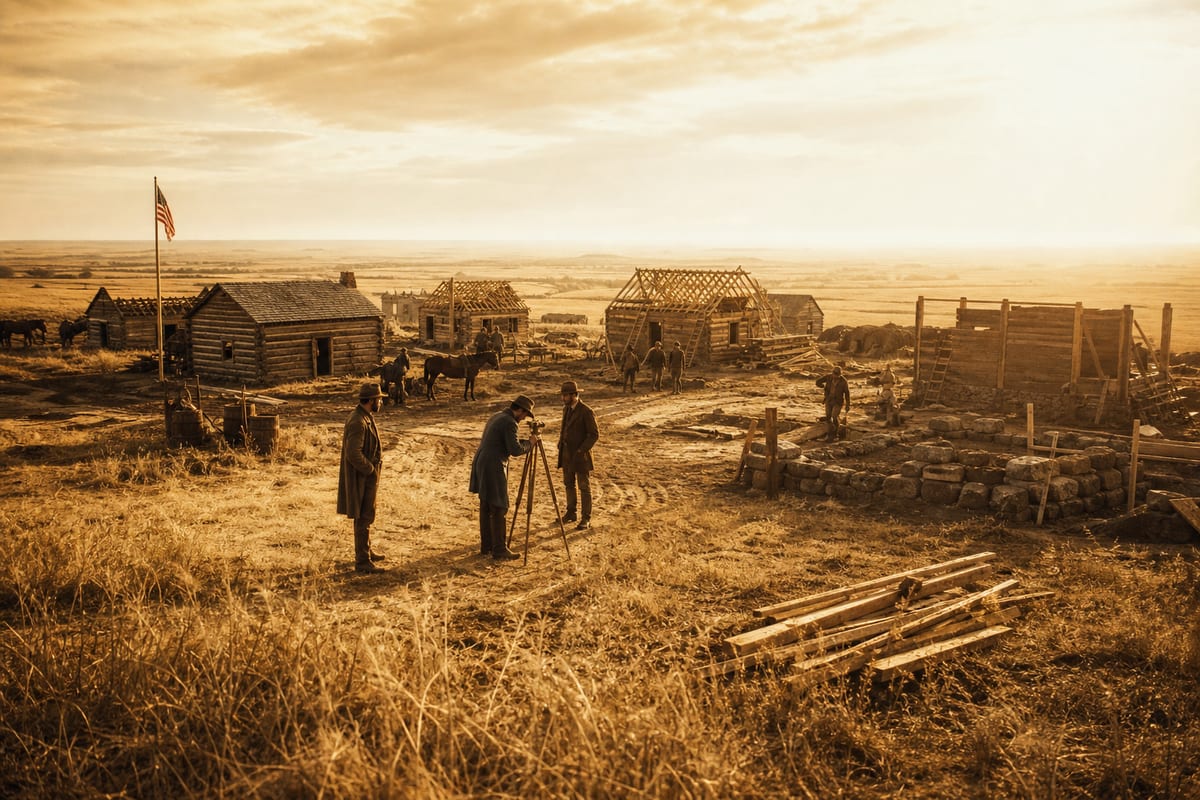
Paola 150 Years, Part 1: Founding on the Kansas Frontier, 1855–1865
The history of Paola begins with an act of Congress and a question about slavery. The Kansas-Nebraska Act of 1854 repealed the Missouri Compromise line that had governed the geography of American slavery for three decades and replaced it with the doctrine of popular sovereignty: settlers in the new territories of Kansas and Nebraska would decide for themselves whether to permit slavery. The practical effect in Kansas was to make the territory a contest between pro-slavery and free-state factions, each racing to establish numerical superiority on the ground before the question was put to a vote.
Into this contested territory, in 1855, came the settlers who platted Paola on the Osage Plains of what would become Miami County.
The Kansas-Nebraska Act and the Opening of the Territory
The settlers who arrived in Kansas Territory in 1854 and 1855 came from both directions. Free-state emigrant aid societies — most notably the New England Emigrant Aid Company — organized and financed the movement of antislavery settlers from the Northeast and upper Midwest. Pro-slavery partisans from Missouri and the broader South crossed the border to stake their claims and, when necessary, to vote in territorial elections whether they were legal residents or not. The result was a settlement landscape in which ideological enemies lived in close proximity and the political stakes of land claims were unusually high.
Miami County’s position in eastern Kansas, adjacent to the Missouri border, placed it at the sharp edge of this conflict. The county’s proximity to Missouri made it accessible to pro-slavery settlers crossing from that state and equally accessible to the antislavery guerrillas and militia companies that operated along the border. The first settlers to file claims in the area that would become Paola arrived in this environment — aware that the land they were claiming was also contested political territory.
Paola was platted in 1855 and quickly designated the seat of government for Miami County. The choice of location reflected practical geography: the site occupied a position on the Osage Plains that offered access to the water sources and transportation routes that would define the county’s agricultural development. The name the founders gave the town — taken from Paola, Italy, in honor of Saint Francis of Paola — was an early indication of the Catholic presence that would shape the city’s religious and educational character in later decades.
Bleeding Kansas and the County Seat
The years between 1855 and 1861 are known in Kansas history as the period of “Bleeding Kansas” — the prolonged, violent conflict over the slavery question that made Kansas Territory a preview of the Civil War itself. Rival territorial legislatures, fraudulent elections, armed militias, and individual acts of violence defined the period. The burning of Lawrence in 1856 by a pro-slavery force, John Brown’s retaliatory Pottawatomie massacre, and the subsequent guerrilla conflict along the Missouri-Kansas border gave the territory a reputation for political violence that lingered long after statehood.
Paola’s experience during this period was shaped by its character as a commercial and administrative center rather than a settlement on the ideological frontier. The town’s courthouse function meant that both pro-slavery and free-state settlers transacted business there — filing land claims, recording deeds, appearing in court. This commercial neutrality gave Paola a degree of insulation from the worst of the surrounding violence, though the county was not immune to the raids, threats, and political upheavals that marked the period.
Miami County’s political alignment was not resolved cleanly before the Civil War. The county’s settler population included people from both Missouri and the free states, and the competing loyalties of those communities created tensions that persisted through the territorial period. By the time Kansas achieved statehood in January 1861, however, the county’s political trajectory had been established: Miami County would enter the Civil War as part of a free state, and its men would serve overwhelmingly in Union forces.
The First Institutions
The founding decade left Paola with the institutional skeleton of a county seat city. A courthouse — modest by the standards of what would later replace it — anchored the central square. Churches appeared early, reflecting the religious commitments that settlers brought from their home communities in the East and Midwest. Schools followed, their quality and continuity limited by the instability of the territorial period but present nonetheless as expressions of the community’s aspiration toward permanence.
Land ownership was the central preoccupation of the founding era, and the county courthouse was its principal instrument. Recording a valid land claim required legal documentation and government recognition — both administered through the county seat. The land transaction records filed in Paola during the 1850s represent the documentary foundation of Miami County’s agricultural development, establishing the property boundaries and ownership chains that would persist for generations.
The newspaper arrived early, as it did in virtually every frontier Kansas community that aspired to permanence. A county seat without a newspaper was a county seat in name only; the local press provided the public record of legal notices, the chronicle of local events, and the boosterish advocacy for the community’s growth that the founders understood to be essential to attracting settlers and investment. The newspapers of Paola’s founding decade were ephemeral — subject to the same instability that plagued all frontier enterprises — but their existence signaled the community’s intention to endure.
On the Eve of War
By 1860, Paola was a small but functioning county seat on the edge of the Great Plains. The violence of the territorial period had subsided enough to allow normal commercial and civic activity to resume. The land question had been substantially resolved — not without continuing disputes, but with enough legal certainty to permit investment and development. The population of Miami County was growing, drawn by the fertile Osage Plains soils and the opening of the territory to free-state settlement.
The election of Abraham Lincoln in November 1860 and the subsequent secession of Southern states transformed the political landscape in which Paola existed. Kansas statehood came in January 1861, making Paola a city in a new state at the moment that state was called to contribute men and resources to a war for the Union’s survival.
Part 2 of the Paola 150 Years series takes up the story with the coming of the Civil War — the men who left Miami County to fight, the guerrilla conflict that came to the border, and the long process of Reconstruction that followed.