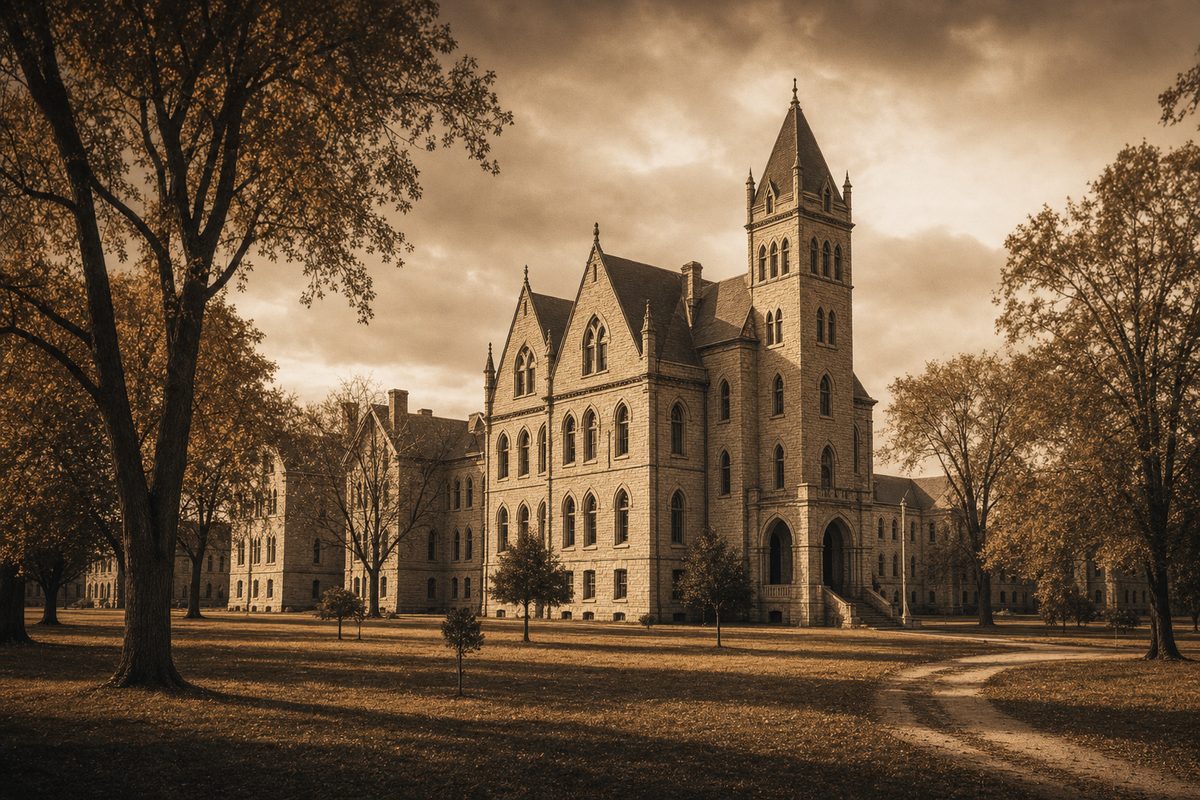
Osawatomie State Hospital: Kansas's First Psychiatric Institution
Osawatomie State Hospital stands as the oldest psychiatric institution in Kansas, an institution whose 150-year arc traces the full sweep of American mental health policy — from the optimistic moral treatment movement of the 19th century through the overcrowded warehousing of the mid-20th century, the upheavals of deinstitutionalization, and into the underfunded crises of the present day. Located in the small city of Osawatomie in Miami County, approximately 50 miles south of Kansas City, the hospital has been a defining feature of local life, the county’s most significant employer, and a window onto larger national debates about how society cares for its most vulnerable citizens.
Founding in Post-Civil War Kansas
The Kansas State Insane Asylum, as the institution was first known, was established by an act of the Kansas Legislature in 1866. The timing was not coincidental. Kansas had achieved statehood only five years earlier, in 1861, and the intervening years had been convulsive: the prolonged violence of the Bleeding Kansas period, the trauma of the Civil War itself, and the daunting task of building functional state institutions from scratch on the frontier.
The selection of Osawatomie as the site reflected a combination of geographic logic and political negotiation typical of 19th-century state institutional placements. The town sat along the Marais des Cygnes River in eastern Kansas, already connected by rail, and offered accessible land for the substantial grounds a 19th-century asylum required. Osawatomie’s location in Miami County placed it within reach of the more densely settled eastern portion of the state, where the patient population was expected to concentrate in the early decades.
The 1866 legislation authorizing the asylum reflected the prevailing reform ideology of the period. Across the United States, the latter half of the 19th century saw a sustained movement — led by reformers like Dorothea Dix, whose advocacy had transformed the national conversation about mental illness — to remove people with psychiatric conditions from county jails, poorhouses, and family attics and house them in purpose-built institutions. The theory was humane at its core: that structured environments, fresh air, useful work, and orderly routines could themselves be therapeutic. Kansas, newly organized as a state, was building the institutional infrastructure its founders believed a civilized polity required.
The first patients were admitted in 1866, and the institution began its long history in modest circumstances. Early records document the difficult conditions of frontier institutional life: inadequate funding, staff shortages, and the challenge of serving a geographically dispersed patient population scattered across a state still being settled.
The Kirkbride Plan and 19th-Century Campus Development
The physical growth of the Kansas State Insane Asylum across the late 19th century followed principles articulated by Thomas Story Kirkbride, a Philadelphia psychiatrist whose 1854 treatise On the Construction, Organization, and General Arrangements of Hospitals for the Insane had become the dominant blueprint for American psychiatric hospital design.
The Kirkbride Plan was premised on the therapeutic power of architecture itself. The characteristic design called for a central administrative block — housing the superintendent’s office, chapel, and formal public rooms — from which long residential wings extended in a shallow V or echelon pattern, stepped so that each ward received adequate light and ventilation. The arrangement was meant to provide graduated levels of care, with the most acute patients near the center and more stable residents in the outer wings. Extensive grounds, including gardens, farms, and walking paths, were integral to the plan. Kirkbride believed the landscape was inseparable from treatment.
The Osawatomie campus grew through successive appropriations from the Kansas Legislature, with major construction episodes in the 1870s and 1880s adding residential capacity, service buildings, and agricultural infrastructure. By the turn of the century, the institution occupied a substantial campus with its own power plant, laundry facilities, bakery, dairy, and working farm — the physical apparatus of a self-contained community.
This self-sufficiency was not incidental. The farm and supporting trades served a dual purpose: they reduced the institution’s operating costs by producing food and services in-house, and they provided the “moral treatment” framework’s central therapeutic element — productive labor. The belief that work itself was curative, that participation in meaningful activity anchored patients to reality and provided structure and dignity, was central to 19th-century psychiatric thinking. Patients at Osawatomie, as at state hospitals across the country, worked the farm fields, maintained the grounds, laundered linens, baked bread, and contributed to the institution’s daily functioning.
The name of the institution changed across these decades, reflecting shifts in social language around mental illness. The original “Insane Asylum” designation gave way to “Kansas State Hospital for the Insane” and eventually to “Osawatomie State Hospital,” the name the institution has carried into the 21st century. Each renaming signaled evolving sensibilities, if not always corresponding improvements in care.
Early Treatment Approaches and the Limits of Reform
The 19th-century asylum movement, for all its reformist origins, operated under profound constraints. Medical understanding of psychiatric conditions was rudimentary, and the treatments available — hydrotherapy, occupational routines, moral suasion, and sedatives — had limited efficacy. More significantly, the institutions designed to provide humane care were chronically underfunded almost from their inception.
As Kansas’s population grew through the 1870s, 1880s, and 1890s, the patient census at Osawatomie rose faster than the legislature’s willingness to fund additional beds. The dynamic familiar to 20th-century observers — more patients than space, staff stretched thin, therapeutic ideals subordinated to custodial management — had roots in the institution’s earliest decades.
Superintendents filed annual reports with the legislature documenting overcrowding and requesting additional appropriations. The records from the late 19th century describe a recurring cycle: population growth, overcrowding, emergency appropriation, construction, brief relief, renewed overcrowding. The therapeutic vision of the Kirkbride Plan required a patient-to-staff ratio that Kansas, like most states, was never willing to fund consistently.
Treatment in this era also reflected the medical limitations of the time. Patients with severe conditions — what would today be diagnosed as schizophrenia, severe bipolar disorder, or major depression — had no pharmacological options. Restraint, isolation, and the structured routines of institutional life were the primary tools. Surgery was occasionally employed in the misguided somatic theories of the early 20th century, which attributed psychiatric conditions to infections or physical abnormalities in other organ systems. The history of early psychiatric treatment is, in significant part, a history of well-intentioned approaches that failed the people they were meant to help.
The Early 20th Century: Growth and Institutionalization
By the early decades of the 20th century, Osawatomie State Hospital had grown into a substantial institution. The patient census numbered in the hundreds, and the campus had expanded well beyond its original Kirkbride core. New construction brought additional wards, expanded agricultural operations, and updated service facilities.
The broader context was a national expansion of institutional psychiatry. State hospitals across the country grew rapidly in the early 20th century as both voluntary admissions and court-ordered commitments increased. The net cast by institutionalization was wide: it caught not only people with severe psychotic conditions but also individuals with intellectual disabilities, epilepsy, substance use disorders, and social deviance of various kinds. The diagnostic categories of the era were broad, and commitment laws were permissive. A person could be admitted to a state hospital on the signature of a single physician with limited procedural protections.
At Osawatomie, the farm operation reached its greatest extent in the early-to-mid 20th century. The institution maintained dairy cattle, hogs, chickens, and crop fields producing grain, vegetables, and hay. Patient labor was central to this operation. The ethical dimensions of this arrangement were rarely examined in the era: patients worked without compensation, in conditions that would not have been acceptable for free laborers, and the institution’s economic functioning depended substantially on that labor. The therapeutic rationale — work as treatment — coexisted with the economic reality that patient labor was financially essential.
Occupational therapy programs expanded during the 1910s and 1920s, influenced by the occupational therapy movement that had developed in part from progressive-era social reform and in part from the rehabilitation needs of World War I veterans. Basket weaving, textile work, woodworking, and other craft activities were introduced alongside agricultural labor as therapeutic modalities.
Treatment Developments in the Mid-20th Century
The mid-20th century brought significant, if not uniformly beneficial, shifts in psychiatric treatment. The introduction of insulin coma therapy in the 1930s and convulsive therapy — first chemically induced, later electroconvulsive — represented the field’s growing willingness to intervene biologically in psychiatric conditions. These treatments were adopted at state hospitals including Osawatomie, with results that were genuinely mixed: some patients improved substantially, others were harmed, and the theoretical rationale for why the treatments worked was poorly understood.
The 1940s and early 1950s saw the patient census at Kansas state hospitals reach its historical peak. The mental hygiene movement of the interwar years had broadened the range of conditions for which hospitalization was recommended. Families with limited options for caring for relatives with serious psychiatric conditions could turn to the state hospital. Veterans returning from World War II with what would now be recognized as post-traumatic stress disorder and other service-related conditions added to the institutional population. Osawatomie, like state hospitals across the country, operated under severe overcrowding. Patient-to-staff ratios were far below therapeutic levels, physical plant was deteriorating faster than funding allowed for repair, and the humanitarian vision of the institution’s founders had given way to custodial warehousing in many respects.
Deinstitutionalization: The 1960s Through the 1980s
The transformation that would most dramatically reshape Osawatomie State Hospital — and every state psychiatric hospital in the United States — arrived in the 1960s with the deinstitutionalization movement.
The movement had several converging causes. The most immediate was pharmacological: the introduction of chlorpromazine (Thorazine) in the United States in 1954, followed by other antipsychotic medications, made it possible for many patients with severe conditions to be managed in community settings in ways that had simply not been possible before. Medications did not cure psychiatric illness, but they could control symptoms sufficiently to allow discharge.
Simultaneously, a powerful civil rights-inflected critique of the state hospital system was gaining traction. Journalists, academics, and advocacy groups documented the conditions in state institutions — the overcrowding, the inadequate treatment, the loss of patients’ legal rights, the physical and sometimes sexual abuse — in ways that shocked the public. Albert Deutsch’s 1948 book The Shame of the States and later exposés had laid groundwork. By the early 1960s, the critique had reached Congress.
The pivotal federal legislation was the Community Mental Health Centers Act of 1963, signed by President John F. Kennedy shortly before his assassination. The act authorized federal funding for a national network of community mental health centers that would provide outpatient services, crisis intervention, and transitional housing — theoretically enabling discharged patients to receive care in their home communities rather than in distant state hospitals. The vision was genuinely progressive: smaller, less isolated, more humane care closer to patients’ families and communities.
For Osawatomie State Hospital, the practical effects were severe and sustained. The patient census, which had peaked in the thousands in the mid-20th century, declined sharply across the 1960s, 1970s, and 1980s. Wards were closed, staff were reduced, and the campus was progressively downsized. The self-sufficient agricultural campus — the farm that had fed patients and provided occupational therapy for nearly a century — was eventually dismantled as its economic and therapeutic rationale dissolved.
The community mental health system that was supposed to absorb discharged patients was never adequately funded. The Kennedy administration’s vision called for 2,000 community mental health centers nationwide; far fewer were built, and those that were built were chronically underfunded. Many patients discharged from Osawatomie and similar institutions fell into homelessness, incarceration, or inadequate boarding-house situations. The transition from hospital to community care, which reformers had imagined as liberation, frequently amounted to neglect under a different name.
Late 20th Century Decline
The decades between 1980 and 2010 were marked by a progressive erosion of resources at Osawatomie State Hospital, reflecting broader trends in state mental health funding across the country. Deinstitutionalization had reduced the patient census, but the remaining patients were, by definition, those with the most severe and treatment-resistant conditions — the patients who had not been able to sustain community living even with medication and outpatient support.
Federal Medicaid policy added a structural funding problem specific to state psychiatric hospitals. The federal statute known as the Institutions for Mental Disease (IMD) exclusion barred Medicaid reimbursement for care in psychiatric facilities with more than 16 beds for patients aged 21 to 64. This exclusion, intended to incentivize community-based care, had the practical effect of cutting off the primary federal health insurance program from precisely the facilities serving the most seriously ill psychiatric patients. State hospitals like Osawatomie operated largely on state general fund appropriations, without the federal matching funds that other Medicaid providers received.
Kansas’s mental health system underwent successive reorganizations across this period as state government grappled with how to structure and fund services. The physical plant at Osawatomie deteriorated. Buildings constructed in the 19th century required substantial maintenance that was deferred year after year. Staff turnover was high, retention difficult, and recruitment challenging in an institution that offered relatively low wages for demanding work in an aging facility.
Historic structures — the original Kirkbride-influenced buildings that had defined the campus’s 19th-century character — were demolished rather than restored as they fell into disrepair. The campus that emerged from this period bore little physical resemblance to the Victorian-era institution that had stood on the same grounds. What remained was a smaller, functionally modern but physically unremarkable collection of buildings, serving a much-reduced patient population under chronic resource pressure.
The 2015 Accreditation Crisis
The structural problems that had accumulated over decades at Osawatomie State Hospital reached a crisis point in 2015. Federal inspectors from the Centers for Medicare and Medicaid Services (CMS) conducted a survey of the facility and found conditions serious enough to trigger the loss of the hospital’s CMS certification.
The findings documented in the 2015 inspection covered a range of serious deficiencies. Inspectors identified problems with patient safety — including incidents of patient-on-patient violence and inadequate supervision — as well as concerns about the physical environment, staffing levels, and the documentation and implementation of care plans. The inspection report described a facility under significant strain, struggling to maintain basic safety standards with the resources at hand.
The loss of CMS certification had immediate practical consequences. Federal Medicare and Medicaid reimbursements for patients at Osawatomie were cut off. The state was forced to transfer patients to other facilities, reducing the hospital’s census and leaving Kansas with fewer inpatient psychiatric beds at a moment when demand for acute psychiatric care was not declining. The crisis at Osawatomie contributed to what advocates described as a public psychiatric bed shortage across the state, with emergency departments serving as de facto psychiatric holding facilities and jails absorbing individuals in acute psychiatric crisis.
The accreditation loss drew significant media attention, both within Kansas and nationally. Investigative reporting documented the conditions that had led to the federal action and examined the funding decisions — years of legislative appropriations that had not kept pace with the facility’s needs — that had contributed to the deterioration. State officials faced pressure to address the situation, and the Kansas Legislature took up the question of psychiatric funding in ways it had not for years.
Recovery of CMS certification required sustained effort and investment. The state committed resources to staffing increases, physical plant improvements, and policy changes designed to address the deficiencies identified by federal inspectors. The process of remediation extended over years, reflecting the depth of the problems that had accumulated.
Current Status and Ongoing Challenges
Osawatomie State Hospital continues to operate in the 21st century under the oversight of the Kansas Department for Aging and Disability Services (KDADS). The facility serves adults with serious and persistent mental illness who require inpatient psychiatric care, functioning as a safety-net institution for patients who cannot be managed in community settings or private hospitals.
The hospital’s current capacity is substantially smaller than its mid-20th-century peak. The patient census reflects both the legacy of deinstitutionalization and the ongoing pressure of inadequate community mental health infrastructure. Kansas, like many states, has found itself caught in a structural bind: the state hospital system was downsized on the premise that community care would fill the gap, but community care was never adequately funded to do so.
Debates about Osawatomie State Hospital’s future — its appropriate size, its role in a broader continuum of psychiatric care, its funding needs, and the physical plant investments required to maintain safe and therapeutic conditions — continue in Topeka and in the advocacy community. The federal IMD exclusion remains a structural funding obstacle. Workforce challenges, including recruitment and retention of psychiatric nurses, social workers, and physicians in an institution that has struggled with its reputation, present ongoing operational difficulties.
Osawatomie, Kansas: A City Defined by Its Hospital
Understanding Osawatomie State Hospital requires understanding the city of Osawatomie itself, and the relationship between the two has been foundational for more than a century and a half.
Osawatomie — the second-largest city in Miami County after the county seat of Paola — had a population of approximately 4,300 at the time of the 2020 census. The state hospital has been the city’s largest employer through most of its history, and the institutional payroll has been a significant factor in the local economy. When the hospital’s staffing levels have been cut, the effects have rippled through local businesses and households.
The city’s most famous historical association is with the abolitionist John Brown. Brown’s brother-in-law, the Reverend Samuel Adair, was an early settler in the area, and Brown used the settlement as a base during the violent Bleeding Kansas period of the mid-1850s. The Battle of Osawatomie in August 1856 — in which Brown and a small group of free-state fighters clashed with a larger force of pro-slavery Missouri Border Ruffians — was a defining moment in the guerrilla conflict that prefigured the Civil War. Brown’s forces were dispersed and his son Frederick was killed in the engagement. The battle and Brown’s role in the struggle against slavery elevated Osawatomie’s name in antislavery circles and gave the city an identity it has maintained.
The John Brown Museum State Historic Site preserves the Adair cabin, a log structure from the 1850s that is one of the few surviving physical connections to the Bleeding Kansas period in Miami County. The museum maintains interpretive materials documenting Brown’s life and the broader context of the territorial conflict over slavery. The connection between Osawatomie’s 1850s identity as a center of antislavery activity and its 1866 designation as the site of Kansas’s first state psychiatric institution reflects the overlapping layers of history that characterize the city’s past.
The state hospital’s campus, located on the city’s outskirts, was itself a defining feature of the local landscape for generations. Residents who grew up in Osawatomie in the 20th century describe the institution — its characteristic Victorian-era silhouette in early decades, its extensive grounds, the figures of patients who moved through the surrounding streets — as simply part of the backdrop of daily life. The hospital’s presence was neither exotic nor alarming to those who had grown up alongside it; it was a fixture, an employer, a neighbor.
Significance for Miami County History
Miami County’s history is written in layers: the Osage Nation, who occupied the land before American settlement; the early missions and trading posts of the 1820s and 1830s; the free-state settlers of the 1850s; the agricultural economy that dominated the late 19th and early 20th centuries; and the institutional anchors — county courthouse, schools, hospitals — that gave the county’s communities their civic character.
Osawatomie State Hospital belongs to that institutional layer in a particularly significant way. For more than 150 years, the hospital has been among the most consequential public institutions in Miami County — not because of any single dramatic event, but because of the sustained, unglamorous work of providing care to people who had no other place to go.
The institution’s history also mirrors Miami County’s experience of broader American historical forces: the post-Civil War push to build state government infrastructure; the progressive-era faith in institutions as instruments of social improvement; the mid-20th-century expansion of government’s role in social welfare; the fiscal conservatism and ideological skepticism of institutions that characterized the late 20th century; and the ongoing struggle, in the early 21st century, to maintain adequate public services with constrained public resources.
The patients who passed through Osawatomie State Hospital across its 150-plus-year history were Miami County residents, Kansans, and in many cases people with no other connection to the area — individuals who ended up in Osawatomie because that is where Kansas sent people like them. Their stories are largely undocumented in the public record; institutional records were often sparse and are not publicly accessible. But their presence — the tens of thousands of people who lived within the hospital’s walls across a century and a half — is a significant and often overlooked dimension of Miami County’s past.
Osawatomie State Hospital stands as a reminder that institutional history is human history, and that the story of how a community cares for its most vulnerable members is as revealing as any account of political achievement or economic development. The hospital’s arc — from hopeful reform institution to overcrowded warehouse to crisis-struck facility to ongoing, imperfect, but continuing operation — is a story that Miami County shares with the nation.