Railroad History of Miami County, Kansas
Before the Rails: Isolation and the Wagon Road Economy
In the years immediately following Miami County’s establishment in 1855, movement of people and goods depended entirely on unpaved wagon roads and the region’s rivers. The Marais des Cygnes River provided some waterborne transportation, but its shallow, seasonal character made it unreliable for heavy freight. Farmers hauling grain to market faced exhausting overland journeys to Kansas City or the Missouri River, with weather, mud, and wagon breakdowns adding cost and delay to every load.
The economic consequences of this isolation were significant. Miami County’s agricultural potential — the deep, fertile soils of the Osage Plains were capable of producing wheat, corn, and livestock in quantity — could not be fully realized when the cost of getting goods to market consumed most of the profit. Early settlers recognized that rail access would be the pivot point separating subsistence farming from commercial agriculture.
The national railroad expansion following the Civil War brought the possibility of rail service to eastern Kansas within reach. The Missouri, Kansas and Texas Railway — organized in 1866 and known almost universally as the “Katy” from its MKT initials — became the line that would reshape Miami County’s economic geography.
The Missouri, Kansas and Texas Railway Arrives
The MKT Railway’s southward push through eastern Kansas was one of the defining infrastructure events in the region’s history. Chartered to build from the Kansas-Missouri border to a connection with the transcontinental railroad system further south, the Katy drove its tracks through the prairie in the early 1870s, following the broad corridor of eastern Kansas that offered relatively level terrain and access to the Missouri border markets.
The line’s arrival in Miami County brought Paola, the county seat, into direct rail connection with Kansas City. The implications were immediate and far-reaching. Agricultural commodities that had once required multi-day wagon hauls could now reach Kansas City markets in hours. Land values along the rail corridor rose sharply. Merchants established businesses near the depot. Paola’s downtown commercial district, much of which dates architecturally to the 1880s and 1890s, reflects the prosperity that rail access made possible.
Louisburg, in the northern part of the county, also benefited from rail connectivity as the network expanded. The presence of rail service in multiple county towns created a distributed agricultural shipping infrastructure, with grain elevators and livestock pens clustered near depot sites throughout the county.
The Railroad Depot as Community Hub
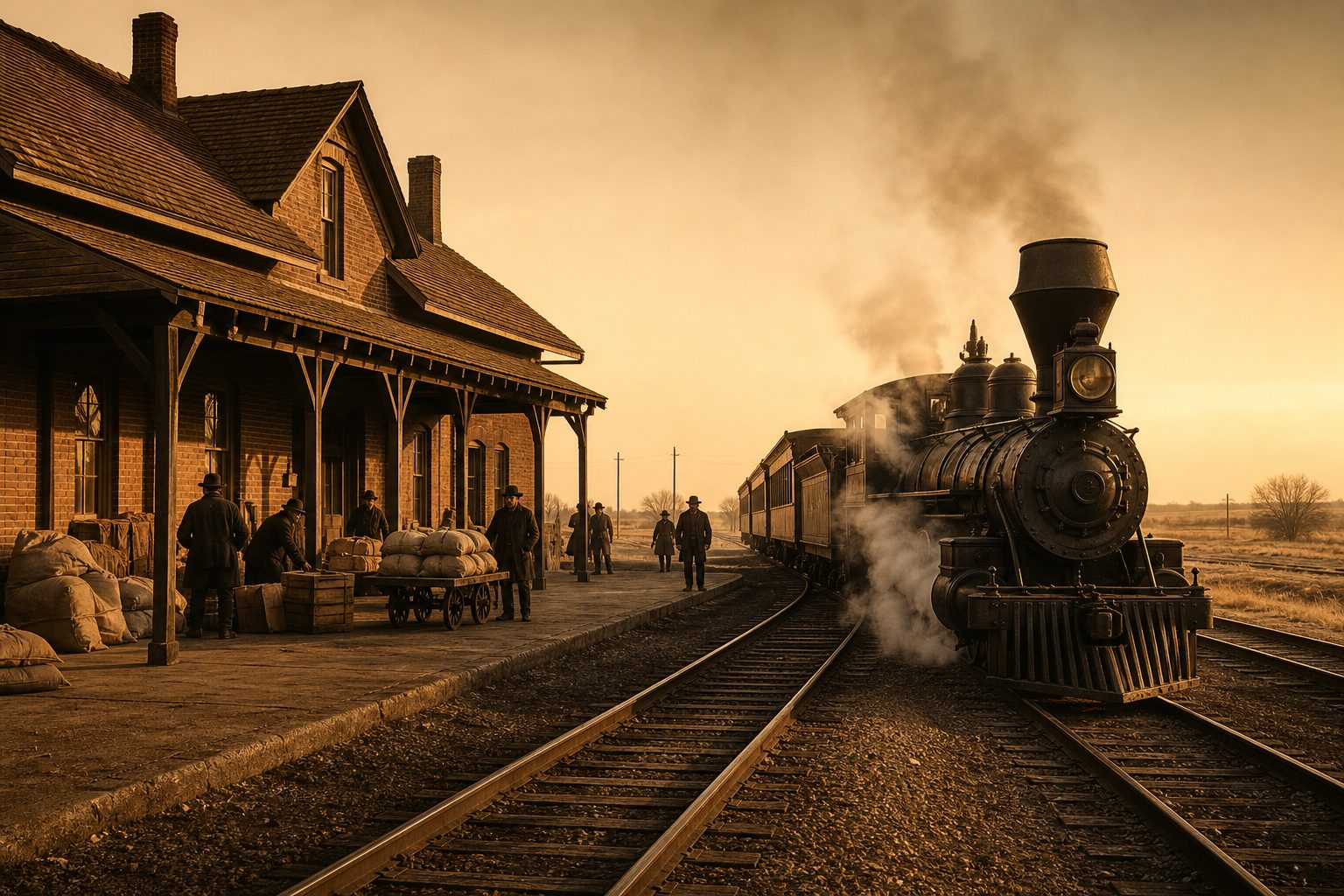
In the late 19th century, the railroad depot occupied a central role in Miami County town life that extended well beyond freight. Passenger service meant that a trip to Kansas City — once a serious undertaking — became a day’s journey. Residents traveled to the city for medical care, legal services, wholesale purchasing, and family visits. The depot was where newspapers arrived, where parcels were collected, and where travelers departing or arriving from distant places passed through the community’s daily life.
Paola’s Katy depot served as both an economic node and a social gathering place. Train schedules structured daily activity in ways that are difficult to appreciate in retrospect. Local newspapers published arrival and departure times, and the depot agent was often among the better-informed people in town, receiving wire dispatches and shipping manifests that gave a running picture of regional commerce.
The depot also served as an employment center. Station agents, freight handlers, track maintenance crews, and the ancillary workers who serviced locomotives and rolling stock represented a significant payroll in towns that otherwise depended primarily on agriculture for income. Railroad employment offered wages and relative stability compared to the seasonal and weather-dependent rhythms of farm work.
Agricultural Commodities and the Rail Economy
Miami County’s railroad economy was built on moving agricultural commodities. Wheat was the dominant grain crop, and Kansas wheat commanded premium prices in Kansas City’s grain markets, but only when it could reach those markets efficiently. The Katy’s freight service made large-scale wheat production economically viable across Miami County’s uplands.
Livestock — cattle, hogs, and sheep — moved through the county’s railroad shipping pens in substantial numbers. The late 19th century saw the development of integrated livestock operations that combined grazing on Miami County’s native grasslands with fattening on corn before shipment to Kansas City’s stockyards. The stockyards at Kansas City were among the largest in the nation, and Miami County producers had direct rail access to them via the Katy.
Timber products from the county’s woodlands along the Marais des Cygnes also moved by rail in the early decades. As the county’s woodland cover was converted to cropland and pasture, this traffic declined, but for a generation it represented a meaningful additional freight stream.
In the other direction, the railroad brought manufactured goods, building materials, and consumer merchandise into the county at prices and in quantities that were impossible by wagon road. Hardware, dry goods, farm machinery, and household furnishings arrived by rail and were distributed from depot-side warehouses to retailers across the county.
Late 19th-Century Prosperity
The decades from the 1870s through the early 1900s represented Miami County’s first significant prosperity driven by rail access. The county’s population grew, new towns were platted, and the brick commercial architecture that survives in Paola’s downtown — courthouses, hotels, banks, and storefronts — was financed by the wealth that rail commerce generated.
County newspapers from the period document a bustling agricultural economy with significant livestock and grain markets, active real estate trading, and the civic institutions — schools, churches, fraternal organizations — that accompany broad-based economic development. The railroad was not the only factor in this growth, but it was the enabling infrastructure without which the rest would not have been possible.
The Highway Challenge and Decline
The arrival of the automobile and the gradual improvement of county roads in the 1910s and 1920s began, slowly, to undercut the railroad’s monopoly on rural transportation. For short hauls to local markets, the truck offered flexibility that the fixed-rail system could not match. Branch-line freight traffic began to erode as farms and businesses shifted short-distance shipping to motor vehicles.
The federal highway system’s formalization in 1926, followed by the paving of major routes through Miami County in subsequent decades, accelerated this process. Passenger service on rural rail lines faced competition from the automobile that was ultimately decisive. By mid-century, most passenger service on Miami County’s rail lines had ended, replaced by private automobile travel and bus service.
Freight operations persisted longer than passenger service, sustained by bulk agricultural commodities that the railroad could move more economically than trucks over long distances. But the extensive local branch-line network of the early 20th century contracted steadily as operating costs outpaced revenues on lightly used segments. Line abandonments, which required Interstate Commerce Commission approval, became a recurring feature of the railroad landscape from the 1950s onward.
Legacy
Miami County’s railroad history is legible in the landscape — in grain elevator complexes that stand near former depot sites, in the straight-line right-of-way corridors that cut across township grids, and in the commercial streetscapes of Paola and Louisburg that date architecturally to the rail prosperity of the late 19th century. The Katy Railroad’s passage through eastern Kansas was one of the formative infrastructure events in the county’s development, and its legacy persists in the physical form of communities that grew up around the promise of rail connection to the wider world.