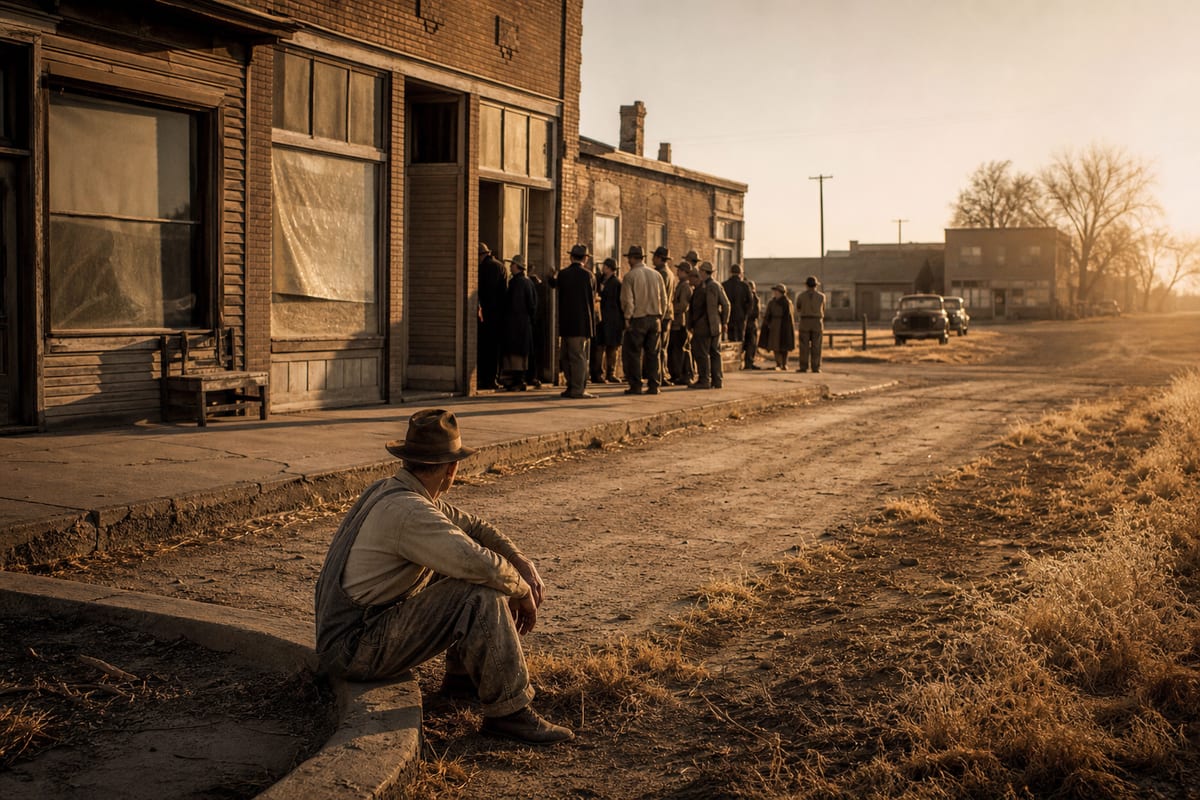
Paola 150 Years, Part 5: Hard Times and Second War, 1920–1945
Part 4 of this series closed with Paola absorbing the changes of the Progressive Era and World War I — a community that had navigated civic reform, technological disruption, and a global conflict and emerged, in 1920, with its institutions intact and its county seat status secure. The next quarter century would subject Paola and Miami County to a different order of stress. The 1920s brought the contradictions of national Prohibition. The 1930s brought an agricultural and economic catastrophe without precedent in the county’s experience. World War II then mobilized an entire generation before the period ended.
The years between 1920 and 1945 were, by any measure, the most difficult sustained stretch in Paola’s 150-year history.
Prohibition and Its Contradictions
National Prohibition took effect in January 1920 with the Eighteenth Amendment and the Volstead Act. For Kansas, which had maintained constitutional prohibition since 1880, the federal overlay formalized an existing legal framework while dramatically raising the stakes of enforcement. What had been a state-level compliance problem became a federal crime, with federal law enforcement resources theoretically available to supplement the county and municipal apparatus.
In practice, Prohibition in Miami County played out much as it did across rural and small-town America: imperfectly, with wide variation in enforcement effort, and against the persistent reality of a market that illegal alcohol suppliers were happy to serve. The county’s border with Missouri — where legal liquor flowed freely until 1920 and where legal and illegal supply networks continued to operate — meant that determined Miami County residents had ready access to contraband if they chose to seek it. Rural roads and the automobile provided the logistics.
The political culture of Prohibition enforcement reflected the community’s mixed feelings about the law itself. Dry advocates — who included most of the Protestant clergy and the women’s organizations that had fought for prohibition for decades — maintained pressure for rigorous enforcement. Others regarded Prohibition as an intrusion on personal liberty and compliance as optional. The county sheriff and local law enforcement navigated these competing pressures, producing enforcement that was neither thorough nor absent.
The 1920s also brought the cultural dislocations that defined the decade nationally: automobiles expanding the social range of young people, radio bringing distant entertainment into local homes, and a general sense that the Victorian social consensus was under pressure. Paola’s experience of these changes was mediated by its small-city character and its agricultural economic base, which kept the rhythms of rural life more dominant than in the industrial cities where the decade’s cultural transformations were most visible.
The Great Depression
The stock market crash of October 1929 initiated a financial crisis that quickly became a broad economic collapse, and Miami County’s agricultural economy was not protected from its effects. Commodity prices — which had already been declining through much of the 1920s as wartime demand receded — fell further and faster after 1929, squeezing farmers whose land mortgage obligations, equipment debt, and operating costs were fixed even as their revenues collapsed.
Bank failures followed. The county banks that had financed the agricultural expansion of the railroad and Progressive eras now held portfolios of farm loans that borrowers could not service. When depositors sought to withdraw savings from institutions already holding defaulting loan portfolios, the bank runs that resulted produced failures — with consequences that rippled through the entire local economy. Merchants who depended on farm credit to carry seasonal accounts could not extend credit if their own bank had failed. The interconnections of the local economy became transmission mechanisms for disaster.
Farm foreclosures represented the most visible human cost of the Depression in Miami County. Families who had farmed Miami County land for generations — in some cases since the founding era — lost their farms to the banks and investors who held their mortgages. The sheriff’s auctions that transferred these properties were sometimes attended by neighborhood solidarity: local farmers gathered not to bid competitively but to bid the minimum and return the property to its original owners, a form of community resistance to the foreclosure process that was documented across the rural Midwest during the Depression years.
Federal New Deal programs reached Miami County through multiple channels. Agricultural Adjustment Administration payments compensated farmers for reducing production of the surplus commodities that were depressing prices. Public works programs provided employment for workers displaced from both the agricultural and commercial economies. The Civilian Conservation Corps drew young Miami County men into federal work camps that built infrastructure across the country. These programs did not end the Depression, but they sustained the community through its worst years and left behind physical improvements — roads, public buildings, conservation works — that outlasted the emergency.
World War II
The Japanese attack on Pearl Harbor in December 1941 mobilized a community that was still recovering from a decade of economic hardship. Miami County men registered for the draft and volunteered for service in numbers that reflected both the country’s genuine military need and the particular eagerness of a generation that had grown up in Depression conditions to demonstrate their capabilities and contribute to something larger than the constrained circumstances of their youth.
They served in all branches of the armed forces, in all theaters of the war. Some went to the Pacific with the naval and Marine forces that fought the island campaigns. Others served in North Africa, Italy, and the long northwestern European campaign that opened with D-Day in June 1944. Kansas National Guard units were federalized and deployed as part of the broader mobilization. The names of Miami County men killed in action were added to the community’s accumulating record of wartime sacrifice.
The home front in Paola during World War II was organized around the rationing system that the federal government administered for gasoline, rubber, sugar, meat, and other strategic commodities. Ration books, issued to individual households, governed consumption in ways that were logistically complex and sometimes resented but broadly complied with. Victory gardens appeared in yards and vacant lots across the city, supplementing the rationed food supply with home-grown produce. War bond drives organized the community’s financial contribution to the war effort, with local campaigns that used social pressure as well as patriotic appeal to achieve their quotas.
The war’s end in 1945 — in Europe in May, in the Pacific in August — brought Miami County’s veterans home in the months that followed. They returned to a community that had survived the Depression and the war, that was leaner and more experienced than it had been in 1920, and that was ready — with the energy and confidence that victory provides — for the period of growth and expansion that the postwar decades would bring.
Part 6 of the Paola 150 Years series takes up the postwar story — the returning veterans, the baby boom, the highway era, and the steady growth that transformed Paola in the three decades after the war.