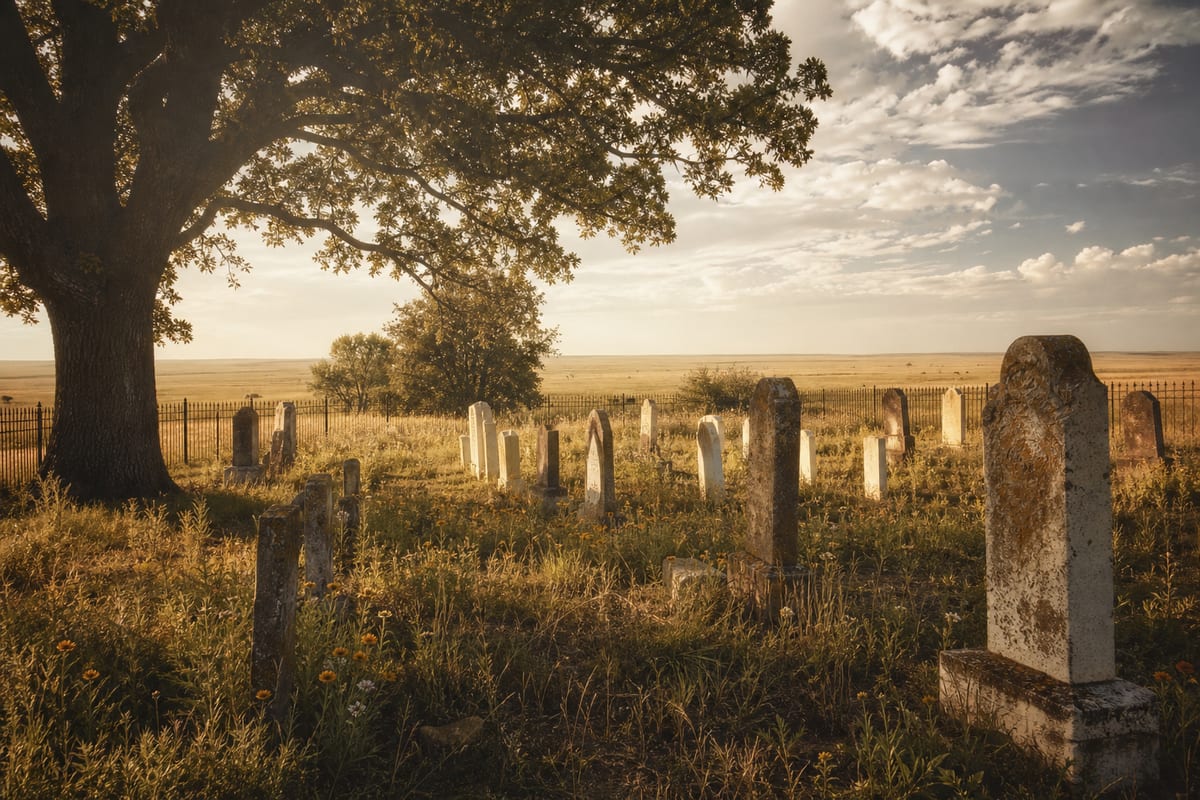
Miami County Cemeteries and Their Value for Family History Research
Why Miami County Cemeteries Matter
A cemetery is a documentary source as well as a memorial. In the context of 19th-century Miami County — where state vital records did not exist until 1911, where church registers varied widely in completeness, and where families sometimes moved without leaving forwarding records — the grave marker is often the most accessible evidence of a person’s dates and family relationships available to a modern researcher.
Miami County was established in 1855 and settled rapidly through the late 1850s and 1860s. The first permanent settlers who arrived during the Bleeding Kansas period, who lived through the Civil War era, and who built the farms and towns of the county now lie in burial grounds distributed across the county’s townships. Those burial grounds constitute a layered archive of the county’s population from its earliest years.
The Oldest Burial Grounds
The Mound Cemetery in Paola, established in the county’s first decade, is the largest and most historically significant of Miami County’s burial grounds. Its name references the earthen features near the site associated with pre-settlement occupation of the area — a reminder that the land on which Miami County’s pioneers built their community had its own earlier history connected to the Native American peoples of the region.
Mound Cemetery’s oldest sections contain the graves of county founders, early merchants, territorial-era settlers, and the families that shaped Paola’s first generation. The burial record here spans from the 1850s to the present, making it one of the longest continuous documentary sequences in the county. For researchers tracing Paola families, the Mound Cemetery is a primary source.
Rural burial grounds from the county’s early period include cemetery plots established alongside the first rural churches — Methodist, Baptist, Presbyterian, and Quaker congregations that organized in the county’s townships during the 1850s and 1860s. These small rural cemeteries often hold the most concentrated collections of a single farming community’s burials: neighbors who arrived together, settled adjacent land, attended the same church, and were laid to rest within walking distance of their farms.
Rural Church Cemeteries
Miami County’s rural church cemeteries are numerous and geographically distributed. Many are associated with congregations that no longer exist: churches that served a farming community for fifty or seventy years and then closed as rural population declined and consolidation reduced the number of rural households. The church building may be gone, but the cemetery often survives — maintained by a cemetery association, a successor congregation, or township authorities — as the primary physical remnant of a rural community that once organized its social life around a particular crossroads.
These rural burial grounds tend to hold the most genealogically dense records for specific farming families. A small rural cemetery near a township crossroads may contain two or three generations of a single family alongside their neighbors: an immigrant couple who arrived in the 1860s, their children who grew up farming the same land, and their grandchildren who carried the family into the 20th century. The spatial clustering of related burials in these small cemeteries reflects the actual social geography of rural Miami County life.
Locating rural cemeteries can require effort. Not all appear on current maps, and some are reached by farm lanes with no public road access. The Kansas Cemeteries project maintained by the Kansas State Historical Society documents known burial grounds by county, including GPS coordinates and basic historical information where available. Miami County genealogy researchers have compiled additional cemetery lists through the Miami County Genealogical Society.
Civil War Veterans and Their Markers
Miami County’s Civil War connections are deep. The county was organized during the Bleeding Kansas crisis, was touched by Quantrill’s Raid in 1863, and sent substantial numbers of men into Union service across multiple Kansas regiments. The veterans who returned — and the many who did not — left their marks on Miami County’s cemeteries in forms that remain readable today.
The U.S. government provided standardized grave markers for honorably discharged veterans beginning in 1873. The classic Civil War-era government marker is a white marble upright stone approximately twelve inches wide and four inches thick, inscribed with the soldier’s name, rank, company, regiment, and state. These markers, issued in large numbers across Miami County cemeteries, identify Union Army veterans and provide military service data that can anchor further research in federal pension records and compiled military service records at the National Archives.
The Grand Army of the Republic (GAR), the fraternal organization of Union veterans that was a significant force in Miami County’s civic life from the 1870s through the early 20th century, often organized veteran sections in local cemeteries and conducted burial ceremonies for deceased members. GAR plot sections, sometimes marked with organization-specific symbols, cluster veteran burials in ways that make identification straightforward.
Using Grave Markers as Research Sources
The information content of a grave marker varies significantly by era and family circumstance. Mid-19th-century markers for immigrant families sometimes record the deceased’s European birthplace — a detail that can anchor the search for earlier records in German, Irish, or Bohemian archives. Family plot markers sometimes include a patriarch or matriarch’s full name and dates alongside the names and relationships of family members buried nearby, providing a structured genealogical record in stone.
Death dates recorded on markers are generally reliable — the date was typically engraved close to the time of death, based on family knowledge. Birth dates are less reliable, particularly for persons born before civil registration in their country of origin: the birth year on a marker reflects family memory rather than documentary verification, and errors of two to five years are common. Researchers should treat marker birth dates as useful starting points for record searches rather than definitive facts.
For the pre-1911 period in Kansas, when no mandatory state registration of deaths existed, a grave marker may be the only documentary evidence of a death date available to a researcher outside of church or funeral home records. This makes cemetery documentation particularly valuable for Miami County families whose members died before the statewide vital registration system was established.
Online Resources and Field Research
The findagrave.com database has indexed a significant portion of Miami County’s cemetery population through volunteer contributions. Indexed entries typically include the marker inscription, photograph of the marker, and sometimes a transcription of the full text. The database is searchable by name, birth year, and death year, and it allows researchers to identify buried individuals without traveling to the cemetery. However, indexing is uneven: some rural cemeteries are comprehensively documented while others are only partially recorded.
The Kansas Cemeteries website, part of the Kansas State Historical Society’s digital resources, provides additional documentation. For cemeteries not indexed online, correspondence with the Miami County Genealogical Society or with local churches and cemetery associations can identify surviving burial records — often handwritten interment registers maintained by the cemetery association — that contain information not transcribed to any digital database.
Field research at Miami County cemeteries — physically walking the rows and reading markers — remains the most comprehensive approach. Markers that have fallen, been damaged, or are partially illegible may not appear correctly in online databases, and spatial relationships between burials that suggest family groupings are better observed in person than through digital records. The Kansas landscape’s rural cemeteries are generally accessible and often contain the kind of firsthand historical detail that no database fully captures.