Quantrill's Raid and Miami County, Kansas
The Making of a Guerrilla Commander
William Clarke Quantrill was born in Canal Dover, Ohio, in 1837, and arrived in Kansas Territory in 1857 as a young schoolteacher. His early years in the territory gave him an intimate knowledge of the landscape and the political fault lines running through the border region. By the time the Civil War began in April 1861, Quantrill had aligned with pro-Confederate Missouri settlers and was participating in irregular violence along the state line.
His path from drifter to guerrilla commander was neither sudden nor simple. In the winter of 1861–1862, Quantrill gathered a small core of followers from the Missouri border counties and received a loosely defined commission as a captain in the Confederate partisan service. The band operated under the general authority of Confederate partisan ranger legislation but functioned largely as an autonomous unit, answering primarily to local Missouri commanders when it answered to anyone at all.
Quantrill’s men were predominantly young Missourians whose families had experienced genuine loss at the hands of Kansas Jayhawkers and Union militias — the same border violence, seen from the other side of the line, that had produced the free-state grievances documented in Kansas history. The war gave these men an institutional framework for settling old scores and new ones.
Border Warfare Tactics
The guerrilla warfare practiced along the Kansas-Missouri border during the Civil War bore little resemblance to the organized campaigns and pitched battles that defined the conflict elsewhere. Quantrill’s band relied on intimate local knowledge, small-unit mobility, and the ability to disperse into the civilian population. Riders operated in groups ranging from a handful of men to several hundred, striking farms, ambushing supply wagons, and attacking small Union garrisons before Union cavalry could respond.
Miami County, situated directly on the Kansas side of the state line, was exposed to this kind of irregular violence throughout the war. The county’s eastern settlements faced the constant threat of raids from Missouri, and its roads — which connected the border counties to the Union supply network at Leavenworth and Kansas City — made it a target for Quantrill’s men seeking to disrupt Federal logistics. Farmers in eastern Miami County kept arms close and maintained neighborhood watch arrangements that functioned as informal militia.
Union forces responded by establishing a series of blockhouses and patrols along the border, but the nature of guerrilla warfare made purely defensive measures inadequate. Quantrill’s riders could assemble quickly, strike hard, and dissolve back into Missouri before pursuit was organized. The result was a sustained climate of insecurity that depleted farm communities, strained local resources, and kept Miami County households in a condition of prolonged anxiety for the better part of four years.
The Lawrence Massacre
The event that defined Quantrill’s historical reputation — and shocked the nation — came on August 21, 1863. Quantrill assembled a force of approximately 450 men, the largest single concentration of Confederate guerrillas of the war, and led them on an overnight ride from Missouri into the heart of Kansas.
Lawrence, the target, was chosen with deliberate symbolic weight. It was the center of Free State organizing in Kansas, the home of the anti-slavery newspaper founded by the New England Emigrant Aid Company, and the base of the Kansas Red Legs — a Union irregular unit that had conducted its own devastating raids into Missouri. Lawrence was also, in the view of Quantrill’s men, an unarmed civilian town, which is precisely what made it vulnerable.
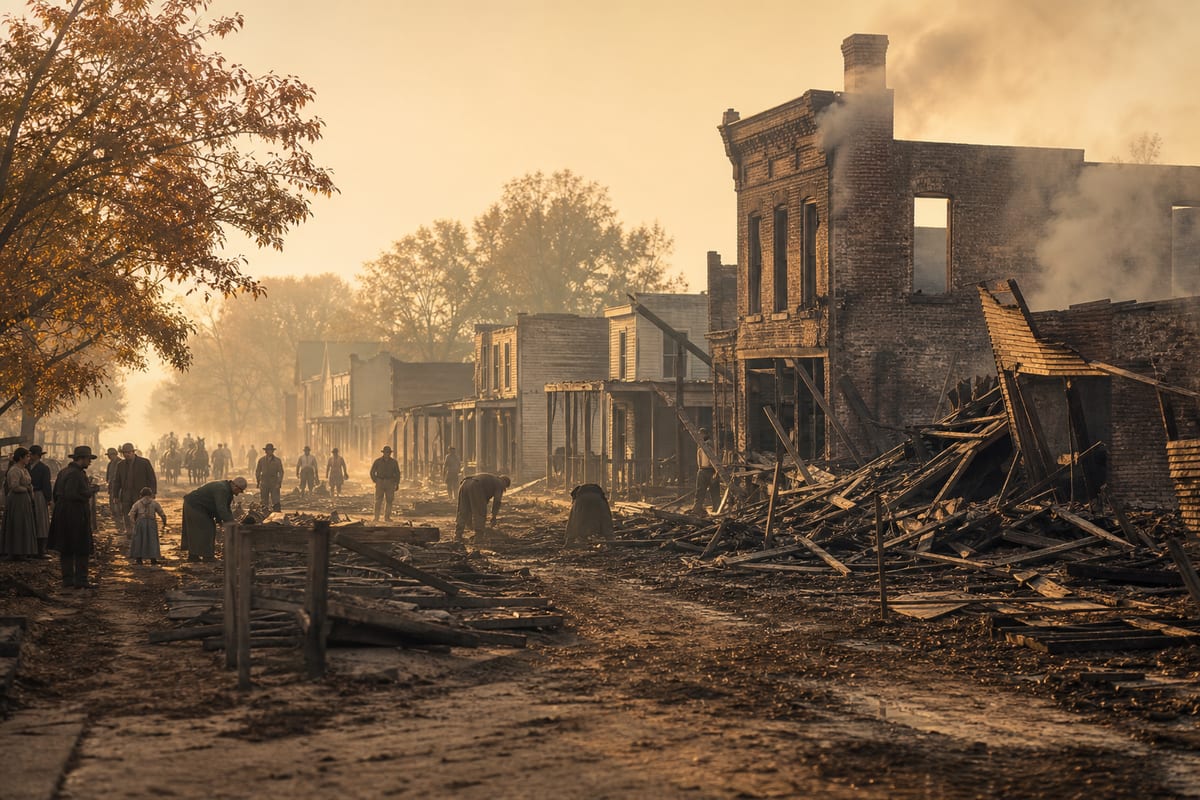
The raiders entered Lawrence at dawn. Over the course of roughly four hours, Quantrill’s men moved systematically through the town, killing nearly every adult male they encountered. Approximately 150 men and boys were shot, many in front of their families. Businesses and homes were looted and burned. When the column finally withdrew toward Missouri, much of Lawrence lay in ruins.
The Lawrence Massacre produced immediate and lasting consequences across the border region, including Miami County. Union commanders in Kansas recognized that Quantrill’s band had demonstrated a capacity for large-scale, organized violence that fundamentally changed the threat calculus along the border. Miami County communities organized more seriously for defense, and the county’s militia units — already active in a border-watch role — were placed on heightened alert. The organized effort to protect the Kansas border counties is documented in the history of the Defense of Kansas.
General Order No. 11 and Its Consequences
Four days after Lawrence, on August 25, 1863, Union General Thomas Ewing Jr. issued General Order No. 11. The order directed the forced evacuation of all residents of four Missouri border counties — Jackson, Cass, Bates, and Vernon — regardless of their loyalty to the Union or the Confederacy. The logic was strategic: Quantrill’s band drew recruits, food, shelter, and intelligence from these communities. Remove the population and the band would lose its logistical base.
The order was carried out with varying degrees of harshness. Tens of thousands of Missouri civilians were driven from their homes, and significant destruction accompanied the evacuation as Union soldiers burned farms and outbuildings to prevent their future use. The human suffering produced by Order No. 11 — documented in George Caleb Bingham’s famous painting and in hundreds of survivor accounts — became a source of lasting bitterness among Missouri families and a powerful recruitment argument for Confederate guerrillas through the remainder of the war.
For Miami County, Order No. 11 had ambiguous effects. It did reduce the immediate threat from Quantrill’s largest concentrations by disrupting the Missouri base of operations. But it also generated new pools of displaced, angry men who filtered into guerrilla service, and it deepened the cycle of retaliatory violence that had defined the border since 1854.
Fragmentation and Decline
After Lawrence, Quantrill’s authority over his band began to erode. The sheer scale of the massacre had brought intense Federal attention to the border, and Quantrill proved unable to sustain the organizational cohesion that had made the raid possible. Subordinate commanders with their own followings — most notably Bloody Bill Anderson and George Todd — increasingly operated independently, conducting their own raids with a ferocity that even Quantrill found difficult to manage.
By 1864, the band had effectively fragmented. Quantrill himself took a diminished force into Kentucky in the winter of 1864–1865, apparently intending to move toward Washington in a final guerrilla operation. He was ambushed by a Union militia force near Taylorsville, Kentucky on May 10, 1865 — weeks after Robert E. Lee’s surrender at Appomattox. Mortally wounded and partially paralyzed, Quantrill lingered for nearly a month before dying on June 6, 1865.
The Legacy in Miami County Memory
The guerrilla war’s legacy in Miami County was not commemorative but cautionary — folded into local memory as a period of sustained threat and neighborhood defense rather than celebrated conflict. The families who had farmed eastern Miami County through the war years carried their experiences into the postwar decades quietly, the violence having been too irregular and too close to home to fit comfortably into the martial heroism that shaped Civil War remembrance elsewhere.
The Lawrence Massacre remains the most studied episode of Confederate guerrilla warfare on the Kansas-Missouri border. Its documentation, through survivor accounts, official reports, and subsequent historical scholarship, provides the clearest window into the kind of irregular warfare that Miami County’s border communities endured for four years — not as a single catastrophic event but as a grinding, persistent insecurity that left its mark on the region long after Appomattox.