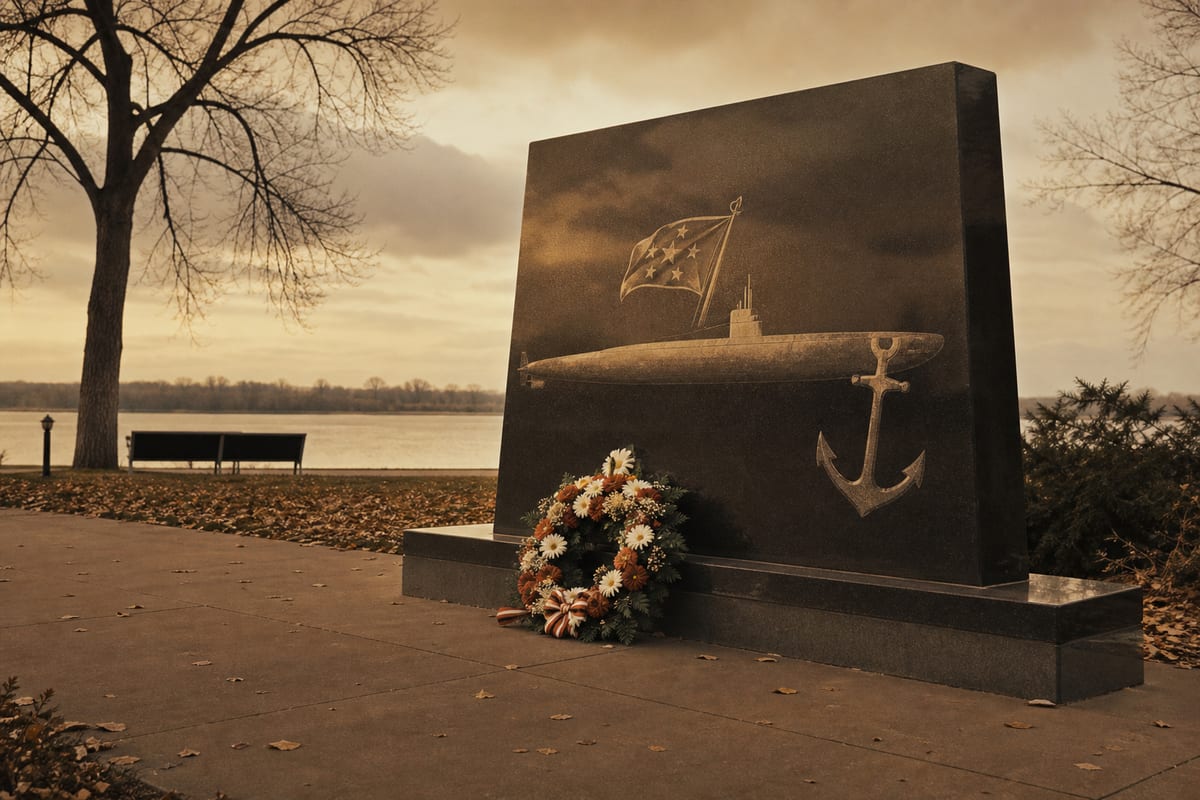
USS Scorpion (SSN-589): Miami County Connections to a Lost Submarine
In the spring of 1968, the Cold War claimed another casualty — not in a spy exchange or a diplomatic confrontation, but 9,800 feet beneath the Atlantic Ocean. The USS Scorpion (SSN-589), a nuclear-powered attack submarine carrying 99 men, disappeared in late May of that year. For communities across the United States, including Miami County, Kansas, the news of the Scorpion’s loss arrived as a personal grief, felt in the particular way that small communities absorb the deaths of their own.
A Submarine Built for the Cold War
The USS Scorpion was commissioned on July 29, 1960, and assigned to the Navy’s Submarine Force Atlantic Fleet. She was a Skipjack-class submarine — a design that represented a significant advance in American submarine technology, pairing a nuclear propulsion system with a streamlined teardrop hull optimized for underwater speed. The Skipjack class could reach speeds in excess of 30 knots submerged, making it one of the fastest submarine designs of the era.
The Cold War provided the Scorpion with a clear mission. The Atlantic Ocean in the 1960s was a contested domain, with American and Soviet submarines operating in constant, largely invisible proximity to one another. Attack submarines like the Scorpion served as hunter-killers — tasked with tracking Soviet missile submarines, gathering electronic intelligence near Soviet naval installations, and standing ready to engage enemy vessels in the event of open conflict. It was dangerous, classified, unglamorous work, conducted in tight quarters by young men who volunteered for submarine duty knowing that the margin for error was vanishingly small.
Between 1960 and 1968, the Scorpion completed numerous deployments in the Atlantic and Mediterranean, accumulating a record of operational service that earned commendations from the fleet command. The crew that departed Norfolk, Virginia, in February 1968 for a Mediterranean deployment was experienced and well-regarded.
The Disappearance
The Scorpion was returning home. After completing operations in the Mediterranean, the submarine had been assigned to observe Soviet naval exercises in the Atlantic before proceeding to Norfolk. On May 21, 1968, the Scorpion transmitted what would be her final routine message. She was expected at Norfolk on May 27.
She never arrived.
When the Scorpion failed to make contact and did not appear at port, the Navy initiated search operations. An official inquiry began on June 5, 1968, and the submarine was formally declared lost the same day. The families of 99 men waited for news that the Navy ultimately could not provide with certainty.
The Navy’s search forces, assisted by the research vessel USNS Mizar, located the wreck in October 1968. The Scorpion lay in approximately 9,800 feet of water, about 400 miles southwest of the Azores archipelago. The hull had broken apart, consistent with either an internal explosion or catastrophic pressure failure during descent. The crew was gone.
The Investigation
A Naval Court of Inquiry convened to determine the cause of the Scorpion’s loss. The investigation faced significant constraints: the wreck lay at crushing depth, and remote survey technology in 1968 was limited. Investigators reviewed acoustic recordings from the Atlantic Underwater Test and Evaluation Center (AUTEC) hydrophone network, which had captured sounds consistent with a violent event aboard the Scorpion on May 22, 1968.
The court concluded that the most probable cause was the accidental activation and detonation of one of the Scorpion’s own MK-37 torpedoes. Under this scenario, a torpedo may have begun a “hot run” — activating its propulsion and detonating within the torpedo room — before any countermeasures could be taken. The explosion would have caused catastrophic flooding, sending the submarine to depth faster than the hull could withstand.
The conclusion was designated “probable” rather than definitive. The investigation file has been partially released over the decades, and alternative theories have been advanced by researchers, including the possibility of a Soviet attack during the nearby naval observation operations, and mechanical failure unrelated to weapons. The Navy has maintained that accidental weapons malfunction remains the most supportable explanation. No theory has achieved certainty.
The loss of the Scorpion, coming just five years after the loss of the USS Thresher in 1963, galvanized the Navy’s submarine safety culture. The SUBSAFE program — already initiated after Thresher — was rigorously expanded and institutionalized. Every American attack submarine built or refit after 1963 underwent SUBSAFE certification, a comprehensive review of all systems that could contribute to hull flooding or loss of depth control. The program has not lost a submarine in the decades since.
Miami County’s Connection
Miami County, Kansas sent sons into the United States military in every conflict and peacetime service generation of the 20th century. The Navy, with its tradition of drawing recruits from across the country’s interior — not only from coastal communities — counted servicemen from eastern Kansas among the crews of ships and submarines throughout the Cold War era.
Historical records document connections between Miami County and men who served aboard the Scorpion. The loss of 99 men was mourned not only in the port cities of the Atlantic seaboard but in small county seat towns like Paola, where military service was a community norm and the names of the lost were known to neighbors, classmates, and families.
The 1960s were a decade in which Miami County, like much of rural Kansas, was sending young men into the military in significant numbers. Vietnam was escalating, requiring Army and Marine Corps conscripts and volunteers. The Navy and Air Force were drawing career servicemen into the permanent Cold War apparatus. Submarine duty, with its additional hazard pay and its reputation for demanding a higher technical aptitude, attracted men who sought a different kind of military service.
The Human Weight of the Loss
The 99 men who died aboard the Scorpion were between 19 and 38 years old. Most were enlisted sailors. A smaller number were officers. They came from every region of the country. Many had families — wives, children, parents — waiting in Norfolk and in communities scattered across the United States.
Unlike battlefield deaths, where the circumstances are at least known and the sacrifice is publicly witnessed, the deaths of the Scorpion’s crew carried an additional weight: ambiguity. No one could say with certainty what happened. No bodies were recovered. The wreck, designated as a military grave, remains on the ocean floor, visited periodically by Navy survey vessels that confirm its position and monitor the condition of the nuclear reactor compartments.
The names of all 99 crew members are inscribed on a memorial at the Naval Station Norfolk, and on the national submarine memorial maintained by the United States Submarine Veterans organization. In the communities that knew these men — communities like those in Miami County — the loss remains a chapter in the ongoing accounting of what military service has asked of ordinary American families.
The cold arithmetic of the Cold War counted the Scorpion among its costs. Miami County counted the cost in more personal terms.