How Paola, Kansas Got Its Name
Anyone who has driven through eastern Kansas and tried to pronounce the name from first glance has likely guessed wrong. “PAH-oh-la,” the Italian-inflected reading, is not how locals say it. In Miami County, the name is “Pay-OH-la” — three syllables with the stress on the middle one, delivered with the flat confidence of someone who has never considered any other option. The pronunciation is a small clue to a larger story: the name is not Italian at all. It belongs to a different history entirely.
The Peoria Tribe in Kansas
To understand why Kansas has a city called Paola, it is necessary to understand the extraordinary forced displacement of Native peoples that preceded American settlement in eastern Kansas.
The Peoria Tribe of Indians is a confederacy — a political union of several originally distinct Algonquian-speaking peoples from the Great Lakes and Mississippi Valley regions: the Peoria, Kaskaskia, Piankashaw, Wea, and Miami. These groups had inhabited the Illinois country for centuries before American expansion pushed them steadily westward through a series of treaties and land cessions in the late 18th and early 19th centuries.
By the 1830s, the federal government’s Indian removal policy was relocating eastern tribes to lands west of the Missouri River. The Peoria Confederacy, under the pressure of successive treaty negotiations, accepted lands in what would become Kansas Territory. These treaty lands were located in the area of the Osage River valley in northeastern Kansas — the same lands that, two decades later, American settlers would claim when the Kansas-Nebraska Act opened the territory in 1854.
The Peoria held their treaty-guaranteed Kansas lands through the 1840s and into the 1850s, maintaining communities and governance structures in a region under increasing pressure from American westward migration. Their presence in the area was a documented, formal, treaty-recognized fact at the moment Kansas Territory was organized.
The Chief Named Paola
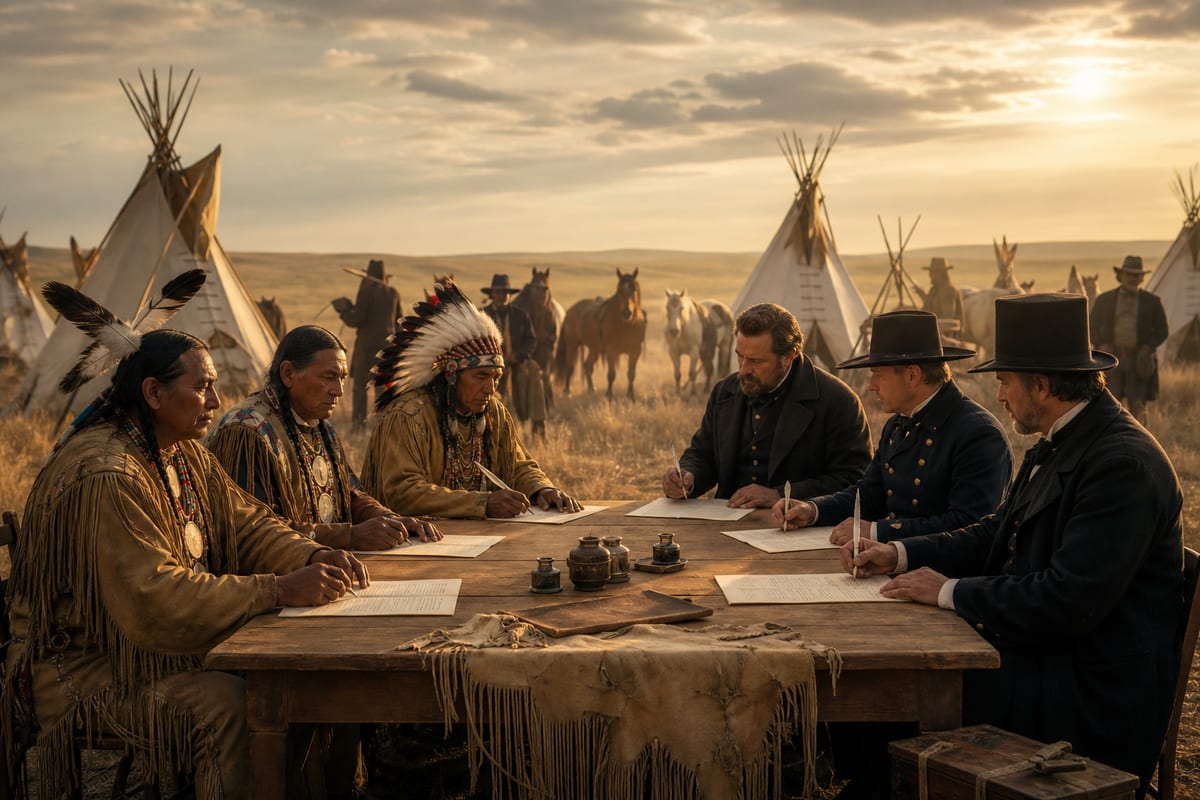
Among the leadership figures of the Peoria Confederacy in this period was a chief known in American records as Paola — sometimes rendered Pa-o-la in 19th-century documents. The historical record on this individual is filtered through the limitations of American record-keeping of the era, which often anglicized, abbreviated, or phonetically approximated Native names with imprecision. What survives in the documentary record is the recognition of Paola as a figure of sufficient prominence that settlers in the new county seat chose to attach his name to their town.
The choice was not incidental. In 1855, the connection between the Peoria Confederacy and the land being settled was immediate and obvious. The treaty lands had only recently been vacated or were still in the process of being transferred. The Peoria were not a distant historical memory — they were recent, present, and known to the people making decisions about what to call the new county seat. Naming the town after a Peoria chief was an acknowledgment, however imperfect, of the people whose treaty rights were being superseded by American settlement.
The 1855 Founding
Miami County was established in 1855, the year following the Kansas-Nebraska Act. The act dissolved the prior legal framework governing Kansas Territory and opened it to organized American settlement, including the deeply contested question of whether the territory would enter the Union as a free state or a slave state. That political context — the beginning of what historians call Bleeding Kansas — shaped everything about the county’s founding.
The county took its name from the Miami people, one of the constituent nations of the Peoria Confederacy. The county seat, established at the same time, took the name Paola. Both names looked back to the Native presence that the American settlement wave was in the process of displacing.
Paola was platted in 1855, laid out in the grid pattern typical of new Kansas towns, with a central square reserved for the county courthouse. It became the governmental and commercial center of Miami County almost immediately, a function it has held for more than 170 years.
The naming occurred in the same year as the broader crisis of Bleeding Kansas. Settlers arriving in 1855 were making urgent and violent decisions about Kansas’s future as a free or slave state. That the county and its seat were named with acknowledgment of the Native peoples preceding them suggests that, amid the political turbulence, the founders retained some awareness of the layered history of the land they were claiming.
The Pronunciation Gap
The divergence between how “Paola” looks and how it is pronounced in Kansas is itself historically revealing. The name arrived in American records as an anglicized approximation of a Peoria chief’s name — not as an Italian word, not as a Spanish word, not as a classical European name of any kind. American settlers wrote it down in a form that happened to match an Italian feminine name, but the phonetic origin was different.
Over time, the local pronunciation — “Pay-OH-la” — settled into the community and has been transmitted across generations of Miami County residents. The “Italian” spelling is an accident of 19th-century transliteration. The pronunciation preserves, in its own imperfect way, the sonic contour of the original name.
This kind of pronunciation divergence is common among place names in Kansas and across the American plains, where Native names, French fur-trade terms, and Anglo-American phonetics met in the 19th century and produced results that confound outside visitors ever since.
Kansas and Native Place Names
Paola is not unique in Kansas’s landscape of place names honoring Native peoples. The state itself takes its name from the Kaw (Kansa) Nation, derived through a Siouan-language term. Osage County and the Osage River preserve the name of the Osage Nation, which controlled much of eastern Kansas before American settlement. Pottawatomie County is named for the Potawatomi people. Shawnee County and the city of Shawnee carry the name of the Shawnee Nation, which was relocated to Kansas Territory in the 19th century. Wichita takes its name from the Wichita people, who inhabited south-central Kansas for centuries.
These names form a layer of historical record embedded in the geography. They do not constitute full acknowledgment of the displacement and loss experienced by the peoples whose names were borrowed — but they function as a persistent reminder that eastern Kansas was not an empty landscape before American settlement. The Peoria Confederacy, the Miami, the Osage, the Potawatomi, the Shawnee, and other nations inhabited, held treaty rights to, or passed through this land before the Kansas-Nebraska Act made it available to American settlers.
What the Name Preserves
The name Paola has been in continuous use since 1855. The city has grown, contracted, rebuilt, and reorganized across those 170-plus years. The original political circumstances that produced the name — treaty lands under pressure, Native leadership being acknowledged even as it was displaced — are well removed from the daily life of a contemporary Kansas county seat.
But the name remains. Every time it appears on a road sign, a court document, or a postal address, it carries a trace of the mid-19th century Peoria Confederacy and the chief whose name was chosen, in 1855, to mark a new American town on land that had been his people’s home. That is, in compressed form, a significant piece of Miami County history — one that begins not in 1855 but in the long occupation of eastern Kansas by Native peoples who preceded the county by centuries.
The question of how Paola got its name leads, inevitably, to that longer story.