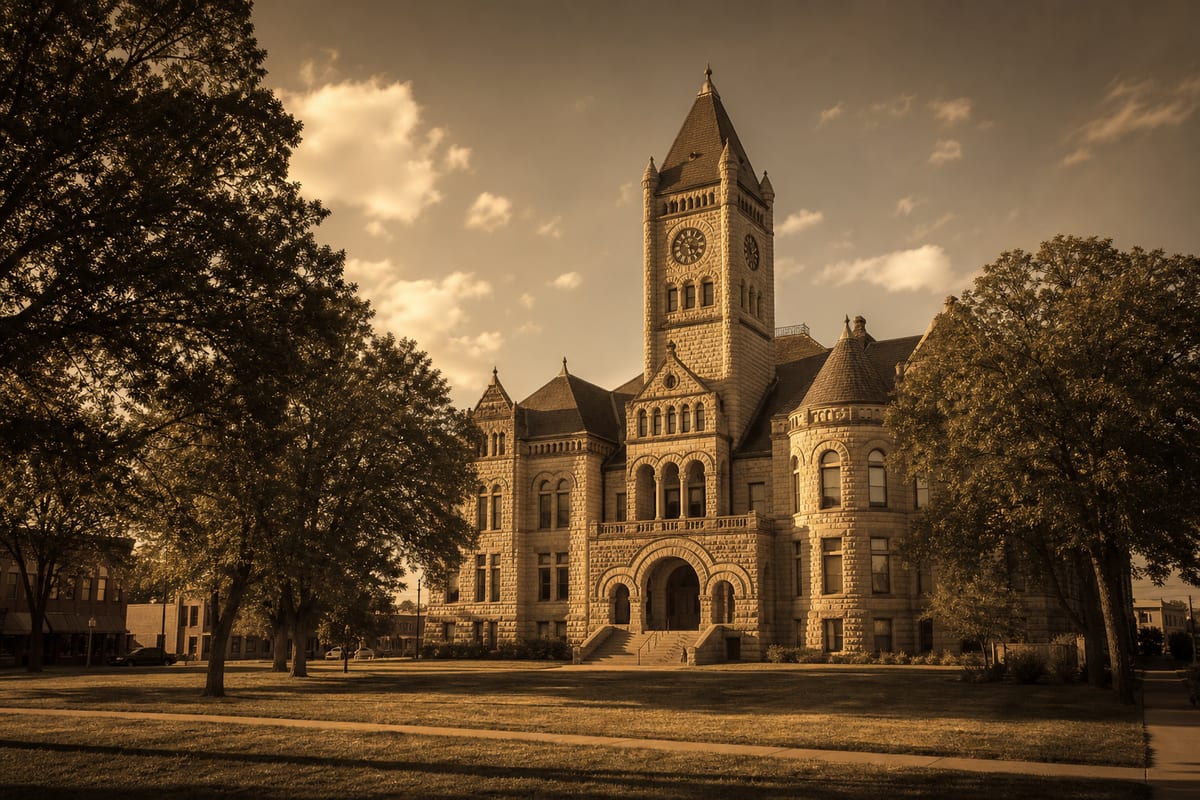
The Miami County Courthouse in Paola, Kansas
The County Seat and Its Courthouse
Paola has been the seat of Miami County government since the county’s organization in 1855, and the courthouse has stood at the center of that function throughout the county’s history. In the tradition of Kansas county government, the courthouse is not merely an administrative building — it is the physical and symbolic anchor of the county seat, the structure around which the town’s commercial and civic life has historically organized itself.
The courthouse square is the oldest planning tradition in American county seat design, imported from the courthouse town model of the upper South and Midwest. When Miami County was organized and Paola established as its seat, the town was platted with the courthouse at its center, commercial blocks radiating outward from the square. This arrangement placed the courthouse in permanent relationship with the stores, offices, and services that grew up to serve county residents who came to town on courthouse business. Paola’s downtown square retains that historic relationship today.
Early Courthouse Structures
Miami County’s first courthouse was a modest affair, as befitted the frontier conditions of the mid-1850s. The territorial period in Kansas was not conducive to substantial public construction — the political turmoil of the Bleeding Kansas years, the uncertainty about Kansas’s future as a free or slave state, and the simple scarcity of capital and labor all worked against ambitious building programs. The county’s earliest courthouse was likely a wood-frame structure adequate for the immediate needs of county government but not intended for permanence.
As Kansas achieved statehood in 1861 and the Civil War era gave way to the postwar period of settlement and development, Miami County’s population grew substantially. The railroad’s arrival in the county in the 1860s accelerated economic growth, and with that growth came the resources and ambition for more substantial public buildings. Counties across Kansas undertook courthouse construction programs in the decades following the Civil War, competing with each other in the scale and dignity of their civic architecture.
The Present Courthouse
The current Miami County Courthouse reflects the architectural ambitions of the late 19th century, when courthouse construction across the Great Plains became an expression of civic confidence and permanence. Kansas counties built courthouses in masonry — limestone was the material of choice across much of the state, given its availability in eastern and central Kansas quarries — with architectural details drawn from the popular revival styles of the era.
The courthouse’s design reflects the Romanesque Revival or Second Empire influences that dominated institutional architecture in the 1870s through 1890s. Romanesque Revival, popularized by architect Henry Hobson Richardson, favored round arches, heavy masonry, towers, and an overall impression of solidity and permanence. Second Empire style, drawing on French imperial precedent, featured mansard roofs, dormer windows, and formal symmetry. Both styles communicated institutional authority and civic aspiration — appropriate messages for a county courthouse expected to serve for generations.
The building’s masonry construction gives it a physical presence suited to its role. Stone or brick courthouses of this era were built to last, and many Kansas county courthouses from the 1870s and 1880s remain in service today, adapted to modern needs while retaining their original architectural character.
The Courthouse as Record Repository
Beyond its governmental and architectural significance, the Miami County Courthouse is one of the most important repositories of historical documentation in the county. The courthouse holds records that reach back to 1855, covering the full span of the county’s organized history.
Property deeds recorded in the register of deeds office trace land ownership from the original government land grants through every subsequent transfer. These records are foundational documents for understanding Miami County’s settlement history — they show which families acquired land and when, how farms were assembled and divided across generations, and how the county’s agricultural landscape took shape over time.
Marriage records, probate files, and court records complement the land records to give researchers a detailed picture of individual and family history. The district court records include not only civil and criminal proceedings but also probate records — wills, estate inventories, and guardianship records — that document the material lives of Miami County residents with unusual specificity. For genealogical researchers tracing Miami County families, the courthouse record rooms are indispensable.
Civic Anchor of Paola
The courthouse’s role in Paola extends beyond government functions. The courthouse square has historically been the gathering place for county events — political rallies, memorial observances, fairs, and the informal socializing that accompanied courthouse days when county residents came to town on legal or administrative business.
Court terms brought attorneys, litigants, witnesses, and spectators from across the county into Paola. The surrounding commercial district served this influx of visitors, and the economic rhythm of the county seat was tied in part to the activity the courthouse generated. This pattern — the courthouse as economic engine of the county seat — was common across Kansas and reflected the centrality of county government to rural life before the 20th century.
The Miami County Courthouse continues to anchor Paola’s downtown square, an architectural landmark that connects the modern county to its history from the earliest days of Kansas statehood to the present.