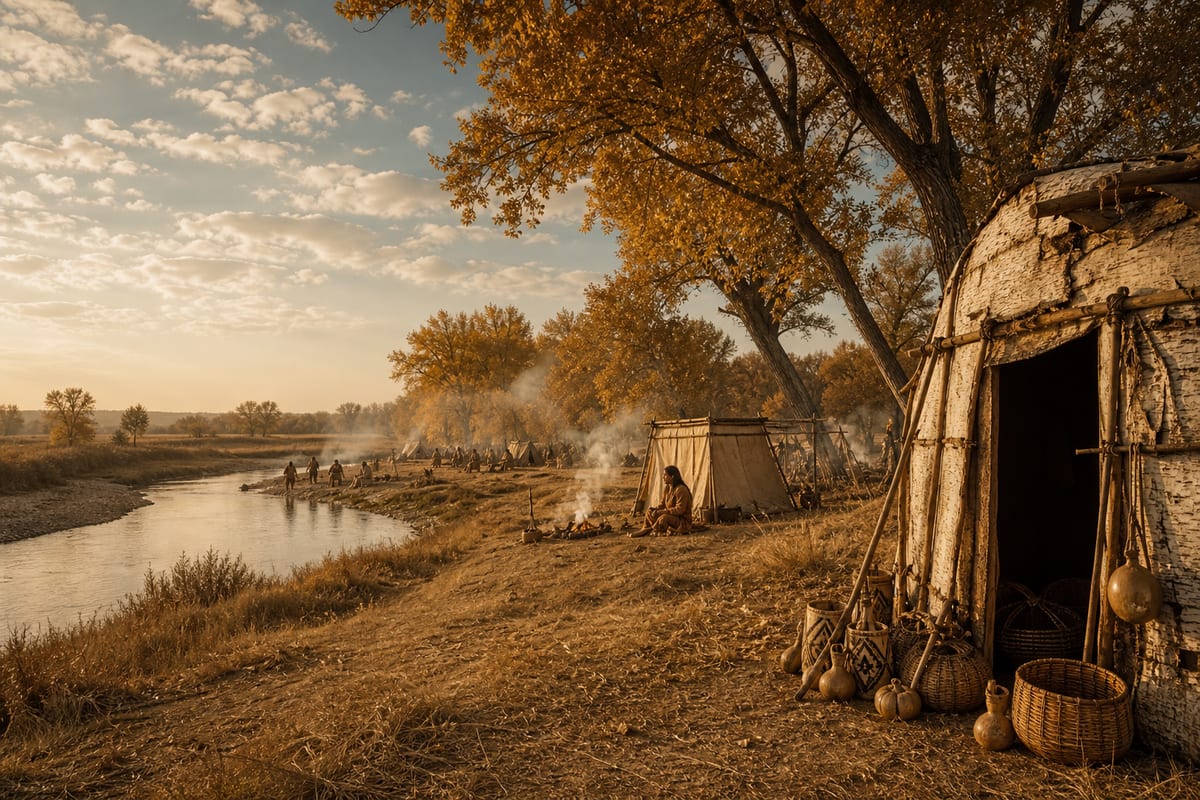
Baptiste Peoria: Chief of the Peoria Tribe in Miami County, Kansas
Baptiste Peoria and the Peoria Confederacy in Miami County
Baptiste Peoria stands as one of the most significant Native American figures associated with Miami County, Kansas during the turbulent mid-19th century. As a recognized leader of the Peoria Tribe, he presided over his people during a period of relentless federal pressure, shrinking treaty lands, and the forced relocation that would ultimately displace the Peoria Confederacy from Kansas altogether. His name — and by extension his legacy — endures in the historical record as a representative of a broader Indigenous story tied directly to the land that became Miami County.
Origins of the Peoria Confederacy
The peoples who formed the Peoria Confederacy were not originally from Kansas. Their homelands lay in the Great Lakes region and the Ohio Valley — lands they had occupied for generations before European contact and the cascading displacement that followed. The confederacy brought together four distinct groups: the Peoria, the Kaskaskia, the Piankashaw, and the Wea. Each had its own history of treaty negotiations, land cessions, and forced migrations stretching from the colonial era through the early decades of American expansion.
By the 1830s, federal removal policy had displaced these peoples from their Illinois and Indiana homelands. Under the Indian Removal Act of 1830 and subsequent treaties, the confederated tribes were assigned lands in the northeastern corner of what would become Kansas Territory. The federal government viewed the arrangement as a solution to the political pressures of removing Native peoples from states coveted by white settlers. For the Peoria Confederacy, it meant rebuilding community life in an unfamiliar landscape under persistent uncertainty about how long even that land would remain theirs.
Treaty History and the Kansas Reservation
The legal framework for the Peoria Confederacy’s Kansas presence rested on a series of treaties negotiated with the United States. An 1833 treaty had established the basic terms of their relocation to lands near the Osage River. By the 1850s, however, the opening of Kansas Territory to white settlement under the Kansas-Nebraska Act of 1854 placed enormous pressure on all Native land holdings in the region.
The Treaty of 1854 formalized the boundaries of the Peoria reservation within what was being organized as Miami County. The reservation encompassed a significant tract, but its survival depended entirely on federal goodwill — a fragile foundation. As American settlers poured into Kansas Territory during the late 1850s, conflicts over land rights intensified. The surveying and allotment of tribal lands became a mechanism by which reservation acreage steadily contracted.
Baptiste Peoria navigated this environment as a tribal leader charged with representing his people’s interests in treaty negotiations and in dealings with federal agents. Such leaders occupied an extraordinarily difficult position: they were expected to speak for their communities in negotiations conducted in a foreign legal and political language, with the balance of power overwhelmingly favoring federal negotiators. The diplomatic record from this period shows tribal leaders consistently pressing for the terms of existing treaties to be honored while federal officials sought revisions that further reduced Native landholdings.
The Name on the Map: Paola
One of the most tangible legacies of the Peoria Confederacy’s presence in Miami County is the name of the county seat itself. When Paola was established as the county seat in 1855, American settlers named it in honor of a Peoria tribal leader. The precise spelling and the specific individual vary across historical sources — some accounts render it “Paolo” — but the intent was clear: an acknowledgment that the county occupied land with which the Peoria people had a recognized treaty relationship.
That act of naming was not without irony. The very communities being established on treaty lands often named their towns and counties after the Native peoples whose land claims those communities were displacing. Miami County itself carries such a name, derived from the Miami people who were part of the broader pattern of Native displacement across the eastern United States. Paola’s name stands as a trace of that history, visible on every map but rarely explained in the context of the treaty relationships it originally referenced.
Removal to Indian Territory
The final chapter of the Peoria Confederacy’s presence in Kansas unfolded through the Treaty of 1867. Under its terms, the confederated tribes agreed to sell their remaining Kansas reservation lands and relocate to Indian Territory — the designated Native homeland in what is now northeastern Oklahoma. The sale price for the Kansas lands was set by federal negotiators; the tribes had little leverage to demand terms more favorable to their interests.
The removal itself followed a now-familiar pattern: the transfer of a community from lands they had occupied for decades to a new and unfamiliar territory, with the expectation that they would reconstitute their lives under new conditions. For Baptiste Peoria’s people, this meant resettling in what became Ottawa County, Oklahoma. The Peoria Tribe of Indians of Oklahoma, which is federally recognized today and headquartered in Miami, Oklahoma, is the direct successor to the confederacy that Baptiste Peoria helped lead during its Kansas years.
A Legacy Embedded in Miami County’s Foundation
The history of Baptiste Peoria and the Peoria Confederacy is inseparable from the founding history of Miami County. The county’s legal organization, the establishment of its county seat, and the patterns of early land ownership all occurred within — and in many cases directly through — the framework of Peoria treaty rights. Understanding Miami County’s 19th-century history requires confronting this Native history not as prologue or background, but as central to the region’s story.
Baptiste Peoria’s role in that story represents the experience of Indigenous leadership under conditions of dispossession: defending what remained of treaty rights, negotiating with a federal system structured against his people’s interests, and ultimately overseeing a removal that ended the Peoria Confederacy’s decades-long connection to Kansas soil. That history is recorded in the treaties, in the land records, and in the name of Miami County’s county seat.